

How to pay off debt? It’s a question and worry for millions. The burden of debt may make everyday finances more difficult than they need to be. You may not know which bill to start with, and you may have many bills to pay and a lot of debt to pay off.
The positive part of this is that it is not essential that you have perfect finances when you are paying off your debt. The important thing is to have a clear idea of what you owe, pick a strategy that suits you, stick to the plan, and make payments on your balances. Let’s work on the best way to pay off credit card debt in this blog!
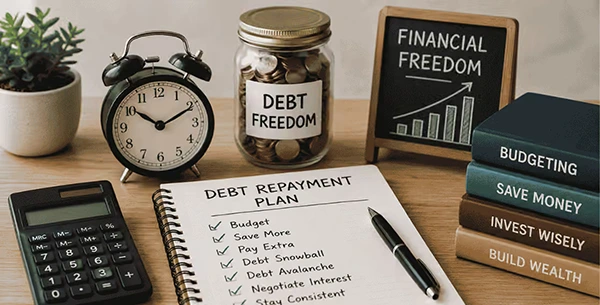
Determine the total amount of debt you have before you decide on a debt repayment plan.
Make a basic listing of each debt and write down the following to find the best way to pay off credit card debt:
For example, you might have a credit card balance of $4,000 at a 24% interest rate, a personal loan of $7,000 at 12%, and a car loan of $10,000 at 7%.
Having it all together makes it easier to grasp. It also lets you know which debts are the most interest-intensive. Please make sure the numbers are correct by looking at your bank statements or online accounts.
If you can’t afford to follow the debt payoff plan, then it is not going to work. The first step is to figure out how much your income is each month. Next is to list out key costs that include:
Then check out extra expenses like eating out, entertainment, subscriptions to magazines, or spending on other items.
It’s not always about getting rid of all the things you love; rather, try to find some spending that you can cut without such a drastic effect that you can’t stick to your budget for a few weeks.
After determining how much money you have left every month, determine how much you can afford to pay toward debt. It’s also best to have a small emergency savings account so that you are not forced to borrow again due to an emergency car repair, medical bill, or other expense.
If you have several debts, you can select from two popular strategies: the debt avalanche and the debt snowball.
The debt avalanche system requires that you make minimum payments on all your debts and funnel any additional funds into the debt that charges the highest interest rate.
After the debt with the highest interest rate is paid off, the funds are channeled towards the debt with the second-highest interest rate.
Typically, this is the mathematically optimum option and can save you more interest in the long run.
This method usually targets the lowest amount of debt first.
While paying off all your bills at the minimum payment, you make an extra payment on the smallest debt. After it’s removed, the next-lowest balance is removed.
The snowball method does not necessarily reduce the amount of interest you have to pay, but if you can pay off a debt quickly, it can give you a psychological lift and keep you motivated.
Which one is the best to choose for how to pay off debt fast? Well, there is not one strategy that works for everyone. The avalanche method might be better if interest minimization is your main priority. If it’s easy to see debt going away fast, the snowball method might be easier to stick with. The best plan is the one that you can stick to.
Check Out: Inheritance Tax: Who Pays It, Common Mistakes, and Importance

Whichever strategy you choose, don’t ignore other debts. Make the minimum payment on all accounts. Late payments may incur penalties, late-charge interest, and harm your credit record.
Once your payments are made on the minimum amount, use any money you can spare to pay off the debt you want to pay off first.
Let’s assume that you have three credit cards:
Card A: $1,000 balance
Card B: $3,500 balance
Card C: $6,000 balance
If you’re following the snowball approach, card A is the one you should focus on first. With the avalanche method, you can choose the card with the highest interest rate. Once the first debt is eliminated, don’t reduce your total debt payment. Pay each one and repeat the process till you are debt-free.

Minimum payments can help to keep the account active and open without issues, but they won’t help to eliminate the debt quickly. If the interest rates are high, paying only the minimum payment can lead you to pay a high amount of interest instead of paying down the balance. Extra compensation is always a good idea.
If, for example, you typically have $100 that you can allocate to paying off a specific debt but then discover that you have another $50 in your budget to pay off that debt, add that to the amount for extra payment.
It is important to be consistent. There’s no need for you to pay a big amount each month. It’s better to have a target you can stick to than an aggressive one that leads to your budget failure.
Debts can be very expensive due to interest, so explore if there are any viable debt reduction strategies.
You may consider doing one or more of the following:
Debt consolidation can also come with dangers. For instance, if you obtain a mortgage loan to finance unsecured debt, you might risk your home should you not be able to make the new payments.
Most importantly, consolidation does not get rid of debts but only restructures them. However, if your spending does not change, you may be getting new debt on top of the consolidated debt.
Check Out: Top Hedge Funds in the World: Rankings, Strategies, and Insights
If new balances are being added on, it will be harder to pay off your debt.
If credit card spending is a problem for you, then you may want to cut back on unnecessary spending on credit cards as you apply yourself to repaying your debts.
This does not always mean that all accounts should be closed. When you close a credit card, it can impact your credit usage and can come with other implications depending on your circumstances.
Rather, concentrate on modifying the behavior that led to the increase in the balance.
Ask if you can afford it before buying it. If this isn’t possible, the addition to a credit card might just be a deferral of the issue.
Don’t just forget to pay a bill if you are not planning to make a payment. Make sure to immediately discuss your situation with your creditor. Depending on the lender and your situation, you might be able to find temporary payment arrangements, hardship programs, or altered terms.
It is important to keep a record of your conversation and ask for agreements in writing.
It’s easier to act early than to wait until a credit card account is delinquent or given to collections.
When your debts are hard to keep up even when you are making the best budget, credit counseling might be a smart choice.
A credit counselor can look at your finances, assist you in formulating a budget, and inform you about your repayment choices. In some situations, they can refer you to a debt management plan, a counseling service that arranges your payments with creditors and will schedule them for you.
Be careful when choosing a debt-relief company. Warning signs of companies are:
Debt settlement is different from debt management. Settlement companies typically persuade creditors to accept a lower settlement than they actually deserve; however, there is a great deal of danger associated with a settlement, such as extra charges, collection efforts, impact on credit rating, and maybe even tax implications.
Please do careful research on any company before signing an agreement so that you can stop paying credit card debt and stop worrying about it.

Sometimes, budgeting and repayment plans will not suffice. If you do not have a consistent surplus of income over living expenses and debt payments, then the more you pay, the more likely you will be to go deeper into debt and the more you will be spending.
These may include formal debt restructuring, insolvency, or bankruptcy proceedings, depending on your country and situation.
These are important decisions, and they may have long-term financial implications, so don’t take them at face value or accept promises from a debt-relief company based on an advertisement. If you feel that you need to talk to someone about your particular case, you may want to seek guidance from a competent financial advisor or legal expert.
When you pay off your final balance, it’s a great accomplishment and an opportunity to change your financial future.
Previously, the funds that were used to pay off debts can now be used to achieve other goals.
You could save money for rainy days, a big purchase, or the long-term goals of your investing, or even pay off the last of an expensive debt.
Look at the reasons why you needed loans, recognize unnecessary spending patterns and disruptive money habits, and try to tackle the issues firsthand to not repeat past mistakes.
The goal is not just to get rid of the loans but to avoid getting into debt again in the future. The idea is to establish a financial system that will help them to avoid unmanageable debt.
Debt payoff isn’t magic but an effective plan that needs to be followed. First, understand exactly what you have to pay, then make a realistic budget and pick a repayment strategy. Continue to make the minimum payment on each debt, with additional funds allocated to reduce your priority debt. Meanwhile, don’t incur additional balances and search for fair methods to lower interest charges.
Find ways to get rid of your debt step by step and learn healthy habits to sort your financial future.
Read Next: Going Concern Assumption: Meaning, Principle, Examples, and Importance in Accounting
Make the minimum payments on all cards and pay off one card at a time. Pay off the card with the highest interest rate first, or pay off the smallest card if you want the wins. Don’t use more credit cards if you’re going to get rid of your debt.
Using your card issuer’s website or mobile application, choose the payment option. Link your bank account, enter the payment amount, and choose the payment date. Be sure to review the information before submitting to prevent late or missing payments.
Make a budget and use as much money as you can that is not necessary to pay off debt. Pay off high-interest debt first, cut down on unnecessary expenses, and pay the debt with any extra cash you receive. Don’t incur new debt that will hinder your repayment efforts.
Sources
- How To Get Out of Debt – By Federal Trade Commission Consumer Advice
- Three Steps to Managing and Getting Out of Debt – By Department of Financial Protection and Innovation