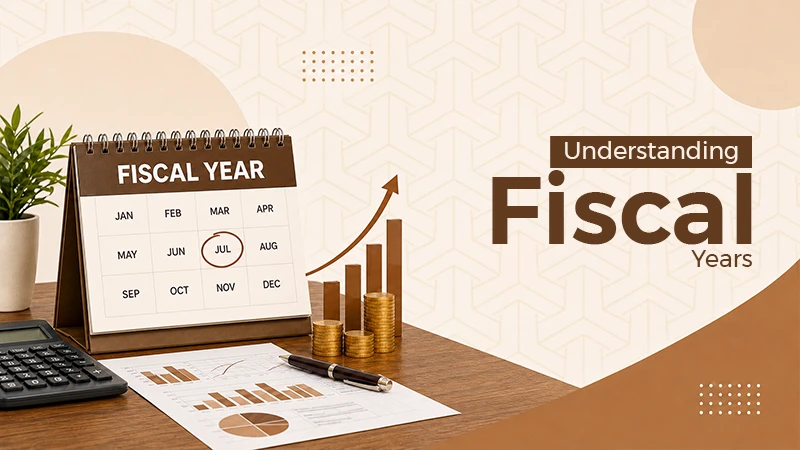


A fiscal year is a 12-month period of time used to report on financial activity, prepare reports, and create a 12-month budget. It encompasses 12 months but is not necessarily the same length as the calendar year or starts in January and finishes in December. A non-standard 12-month period can be used by businesses and other organizations when a unique period is more appropriate for their operations, seasonal sales, or planning cycles.
It is essential to understand how a fiscal year works since this impacts financial reporting, budgeting, tax dates, and comparing the performance of an organization from year to year.

A fiscal year is a period of 12 months that a business, government agency, nonprofit, or other organization uses to account for and report its financial transactions.
It does not necessarily start on January 1st and end on 31st. It can, for example, start on April 1st of the current year to March 31st of the next year.
During this time, an organization will be recording financial data, such as expenses, profits, assets, and revenue. It has the ability to prepare annual financial statements and complete the tax and reporting requirements at the end of the fiscal year.
The fiscal year can be referred to by the year that the calendar year ends in. For example, the fiscal year of April 1, 2025 to March 31, 2026, can be called FY2026.
The fundamental concept is straightforward: an organization decides on a 12-month period as the time frame for accounting and planning. Assume that the company’s fiscal year starts on July 1. It would have a financial year of:
| Period | Fiscal Year |
|---|---|
| July 1, 2025 to June 30, 2026 | FY2026 |
| July 1, 2026 to June 30, 2027 | FY2027 |
The company would take advantage of these to review its income and spending, profitability, and other financial outcomes.
The greatest benefit of selecting a non-calendar fiscal year is that reporting can be based on the organization’s operating cycle. A business that sells a lot in the winter and less in the summer might not want to close its books in the middle of the summer.
A fiscal year can be different from a calendar year, as long as it makes more sense for the business.
In some companies, there are significant fluctuations in sales. For instance, retailers can make a lot of money around the holiday shopping season.
In the event that such a business concludes on December 31, it may be finished during the holiday sales, returns, and stock processing. The year-end in January can offer the business the opportunity to record the entire seasonal cycle in one reporting period.
Comparing financial results is more meaningful if the reporting period is of a comparable operating cycle.
When a business is seasonal, it may be more appropriate to compare one fiscal year to another if both years encompass the same high sales seasons.
A fiscal year may be defined as the planning cycle of an organization. This can simplify the budgeting process for an organization, resource allocation, and measuring the outcome against financial goals. Businesses may also use CFO services for financial planning, forecasting, and strategic decision-making.
An organization might find it easier to coordinate with its accountants, auditors, and other financial professionals when selecting a year-end outside the busiest accounting and tax periods. Using cloud bookkeeping services can also help businesses maintain organized and accessible financial records throughout the fiscal year.
A company may desire to shut its fiscal year following its peak revenue season. A better understanding of cash on hand after the high season can help in planning and future funding.
Also Read: Business Finance: Types, Core Functions, Examples, and More
Not all businesses have the same fiscal year. They may relate to what they report for, their industry, or their operating cycle.
No business has a single fiscal year that is appropriate. The right year-end would vary based on the business plan, nature of the operation, as well as the applicable year-end rules in the US for the business structure.
When deciding on a fiscal year, keep the following in mind:
You’ll need to begin the process by determining the times of the day or week when your business makes the most sales. If the revenue is higher in some months, try to end the fiscal year soon after that month so that you have a more complete picture of the fiscal year cycle.
Specific reporting periods are typical in some industries. Comparing and benchmarking financial information may be easier when it is done after an industry convention.
Not all organizations can select their tax year in their favor. In general, certain business entities choose to maintain their fiscal year on the calendar year basis unless they would satisfy the applicable requirements for maintaining a different fiscal year.
Think about the times of day when your accountant, auditor, or tax professional is likely to be busiest. There may be more time available at the end of the year for professional assistance, since it is outside the tax season rush. Businesses may also use payroll services to manage payroll-related financial responsibilities alongside their broader accounting processes.
Planning with customers, suppliers, investors, and other stakeholders are also influenced by your own fiscal year. Knowing the reporting cycles can help you coordinate the invoicing, contracting, budgeting, and financial information.
Yes, there may be other tax and reporting requirements if you switch fiscal years.
If a company desires to change its tax year, it might require to file IRS Form 1128: Application to Adopt, Change, or Retain a Tax Year in the United States. The business will have to establish a legitimate business rationale or meet a specific automatic approval process, depending on the situation. Businesses with international operations may also need to consider international tax services when evaluating tax-year changes and related reporting requirements.
This can also result in a short tax year between fiscal years. For example, a company could shift its year-end from December 31 to June 30, meaning they might have a transition period of less than 12 months.
The change may impact tax calculations, financial statements, budgeting, and year-over-year comparisons and should be planned before the change is implemented.
Businesses can find it easier to choose and manage a fiscal year by steering clear of a few pitfalls. Let’s discuss them here:
A fiscal year provides an organization with a reliable 12-month timeframe in which to evaluate financial results, to prepare financial reports, and to plan their finances. It can be helpful if a business has a pronounced seasonal trend or if the fiscal year does not align with the calendar year, but it is not always the best choice.
Note that the fiscal year is properly chosen depending on the nature of the operations, industries, business organizations, and applicable tax requirements. When financial planning involves major business decisions, business valuation services can also provide useful insight into the financial position and value of a business.
Read Next: 401(k) Benefits: Advantages, Tax Savings, and How It Works
The fiscal year may begin at any time to suit the accounting and reporting cycle of the organization. It does not have to start on January 1 like a calendar year.
A calendar year is from January 1 to December 31, and any 12-month accounting period that starts and ends in various months is a fiscal year.
A fiscal year is a 12-month period of time that companies and organizations use to analyse their finances, to make financial reports, and to plan budgets. It could be either the same as or a different calendar year.