

For growing businesses, managing lease data becomes one of their major concern. When the business contracts, payment details and other sensitive information are scattered in between the emails, spreadsheets and shared folders, missed deadlines become a routine aspect.
This is where a structured lease management becomes crucial. It makes the process simple by keeping the financial records accurate, simplifying regulations and giving businesses a clear path to meet future expectations.
This post shares more about how businesses can handle lease data with more accuracy and precision.
Key Takeaways
- Centralized lease records make it much easier to complete the reporting tasks with more accuracy while reducing errors.
- A properly maintained lease data makes budget planning practical and results in smooth audits.
- Simplifying contracts results in the accurate delivery of the projects while avoiding the later submissions.
A lease inventory should list every agreement that gives the business the right to use an item for a period of time. This may include offices, storages, vehicles, equipment, machinery, retail spaces, land, or hidden leases inside service contracts.
Many lease data problems begin because the inventory is not finished.
Finance may know about property leases, but not equipment leases directed by operations. Procurement may have vendor agreements that include lease terms. Local managers may modify leases without providing accounting.
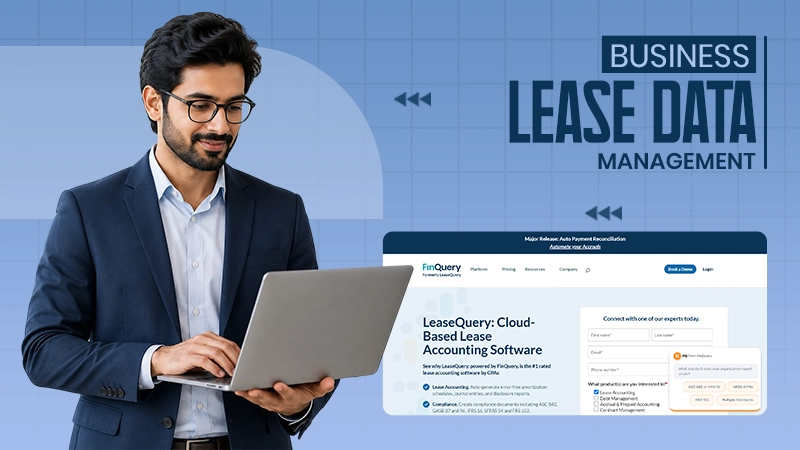
Businesses using ASC 842 lease accounting software can bundle lease records, calculations, documents, and reporting duties in one supervised system.
This makes it easier to preserve a complete view of the lease portfolio.
A lease file should carry more than the signed agreement. Finance teams need structured data that can be used for accounting, predicting, reporting, and analysis.
If lease details are stored in PDFs only, teams still require manual work to decode the information.
Important categories include:
These fields should be defined across all lease types.
Uniform data makes reporting faster and reduces assessment errors.
Lease calculations should always lead back to source documents. This includes signed contracts, rectifications, renewal notices, payment schedules, side letters, termination notices, and paperwork that affects lease terms.
A central document file helps teams verify expectations.
It also lessens audit delays.
Each lease record should have the specified documents attached or clearly linked.
Version control matters.
If an extension changes the lease term or payment schedule, teams should know which version is current and which version has been switched.
Lease data management should get started before a lease is signed. If accounting only receives information about a lease at year-end, reporting becomes hasty and error-prone.
Businesses should establish a formal lease intake process.
Any new lease, renewal, change, or termination should be passed on to finance through a standard form or workflow.
This process should involve legal, acquisition, operations, real estate, and accounting where needed.
A simple intake form can list the asset type, vendor, location, business owner, start date, evaluated term, payment structure, and key options.
The earlier finance gathers the information, the easier it is to employ the correct accounting policy.
Lease data adjusts over time. Payment terms may change. Space may change or shrink. Equipment may be altered. Renewal options may be exercised. A lease may be canceled early.
These changes can affect accounting calculations and announcements.
Teams should not treat edits as informal updates.
Each change should be documented, approved, and examined for reporting impact.
When a lease changes, review:
A clear modification process helps prevent expired data from flowing into reports.
Lease data should have a clear owner. Without ownership, teams may think someone else is keeping records correct.
Finance may own accounting methods, but operations may know when assets are moved or given back. Legal may retain contract documents. Procurement may manage vendor exchanges.
The business should clearly indicate who owns each part of the process.
One person or team should be credited for upholding the master lease record.
Other departments should have clear charges for reporting changes.
Ownership reduces deficits and helps lease data stay fresh.
Lease records should be matched against payments, general ledger activity, vendor records, and operational data. This helps verify missing leases, incorrect payment amounts, duplicate records, and invalid terms.
Monthly or quarterly reviews are useful, especially for companies with many leases.
Compare planned lease payments with actual payments.
Review leases that are near closing.
Check whether any new vendors or repeated payments may reveal an unrecorded lease.
Regular reconciliation keeps lease data accurate throughout the year instead of creating a cleanup project at the last minute.
Good lease data is not only for compliance. It also promotes better business planning.
Leadership can use lease information to monitor future cash goals, renewal decisions, location costs, asset utilization, and long-term promises.
A complete lease schedule helps teams figure out whether to renew, renegotiate, purchase, relocate, solidify, or terminate assets.
It also supports budgeting.
When finance can see future lease payments openly, cash flow planning becomes more accurate.
Lease data should help the business make decisions, not only satisfy reporting demands.
Auditors may ask for lease agreements, calculation support, payment schedules, adjustment history, journal entries, revealing reports, and management views.
Businesses that handled lease data well can respond quickly.
A clean audit file should include source documents, data fields, approval records, co-operation support, and calculation outputs.
Waiting until audit season to handle this information creates additional pressure.
Audit competency should be built into the lease management process from the start.
Also, explore a step-by-step guide to building credit in 2026.
At the end of the day, proper lease management is much more than just storing contracts in a single place. By uniting the records, standardising the data and reviewing the latest information daily, businesses can lower the reporting risks while making smoother financial decisions.
Businesses that consider lease management not as a one-time effort but as a continuous process to create better long-term planning are the ones that take the most advantage of it.
Effective lease data management is important as it reduces the reporting errors while maintaining financial accuracy.
In general, either every month or every six months, outdated information should be removed and alignment should be made between contracts.
It helps to make the reporting faster, improve the accuracy of data and provide better transparency for future contracts.