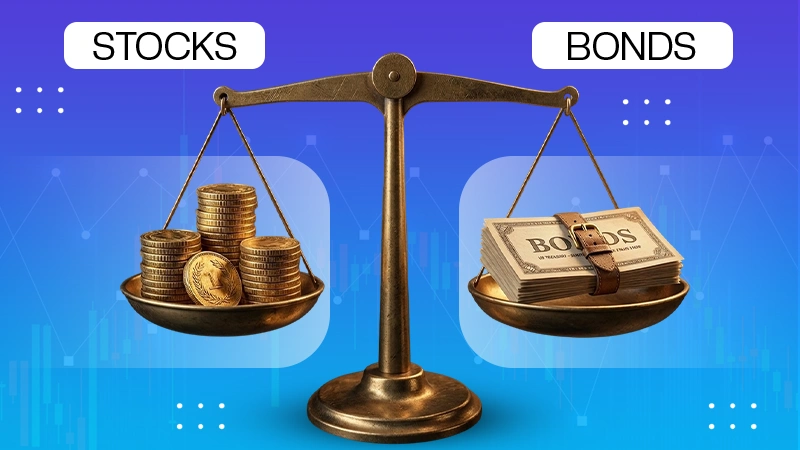


Stocks and bonds are two major types of financial instruments advised by financial experts to invest money in for long-term wealth. Both of these work to multiply the money of individuals, but they are actually entirely different things in the portfolio of an investor.
So before deciding between bonds vs stocks, you must consider the positives and drawbacks and features carefully. Let’s learn about these concepts in detail in this blog.

Stocks are the ownership of a company. By purchasing a stock, you are purchasing some fraction of that business; you are a part owner.
In the bonds vs stocks comparison, stocks are equity investments as they provide the right of ownership. When the company is doing well, then your stock can be of value, and when you sell your stock, you will make a profit. There are also companies that pay dividends, and this offers a lot of income.
Stocks are, however, a risky investment. They might vary according to the market conditions, performance of the company, and economy, which is why the question of stock vs bonds is relevant to the discussion of investors of various risk levels.

Bonds are like the loans that investors provide to companies or governments. When you purchase a bond, you are not purchasing ownership; rather, you are lending the money with the promise of receiving regular payments of interest.
Under the bonds vs stocks comparison, bonds are considered fixed-income investments as they have predictable returns. When the bond is in maturity (expiry of the term), the issuer returns your initial investment.
Although bonds tend to be more stable than stocks, they do not involve “zero risk.” In case the issuer experiences a financial difficulty, he or she may not be able to pay interest or repay the principal.
In order to truly understand the difference between stocks and bonds, you must analyse the key differentiating points.
| Aspects | Stocks | Bonds |
|---|---|---|
| Ownership vs Loan | Provides part ownership of the company. | Are loans to an organization or government. |
| Returns | The sources of returns in the form of dividends and appreciation in prices. It usually has a higher return. | Bonds yield returns in the form of fixed interest. |
| Risk Level | More risky as they are volatile in the market. | Less risky yet have lesser returns. |
| Income Style | The stockholders might end up losing all their money. | Bondholders are paid before stockholders. |
Investors who are willing to take risks may find stocks very rewarding. The possibility of higher returns is another of the greatest benefits of the bonds vs stocks debate.
Thus, while comparing stocks vs. bonds, it should be mentioned that the advantages are associated with more volatility.
Bonds are the most stable, and hence, they are preferred by conservative investors when it comes to deciding between bonds and stocks.
Therefore, in the stock vs bond comparison, stock is ideal in situations where individuals want to have high returns but at the expense of safety.
Also Read: New York Business Entity Search: A Master Guide for Establishing a New Business in New York
The stocks or bonds question does not have a universal answer. It depends on aspects like personal finance, time frame, and risk tolerance.
Choose stocks if:
You seek long-term growth and are able to risk the market changes.
Choose bonds if:
You are more inclined toward predictable revenues and reduced risk.
Financial experts usually advise a balanced portfolio consisting of stocks and bonds to spread the risk and returns in most instances.
For wise financial planning, you must always start with your objective, not the product, when deciding on whether to buy bonds or stocks.
Stocks are usually the main vehicle to achieve your goal of wealth creation since they are directly involved in economic growth. In the long term, equity markets have been shown to outdo inflation.
But bonds are more applicable in case you want stability in your income or to secure your capital. Bonds are used to smooth volatility and give a predictable cash flow.
In real portfolios, it is not a choice between stocks and bonds but having each asset play a role:
Stocks = growth engine
Bonds = stability anchor
It is one of the most important factors in determining stocks or bonds is the time horizon.
For a wise decision, stocks should not be used in short-term objectives, and bonds alone might not outperform inflation on long-term growth.
Through an advisory prism, the largest errors are not related to the selection of the wrong asset, but to the wrong application of the correct use.
The other misconception with the bond stock debate is that bonds are risk-free, but in reality, they are not.
There’s no definite formula that explains the numbers to invest in both these instruments; however, a common starting point is:
Equity Allocation = 100 – Your Age
For Example,
Age 30 = 70% stocks, 30% bonds
Age 50 = 50% stocks, 50% bonds
This is, however, just a start and would be adjusted according to the following:
To make effective investment decisions, it is important to know the distinction between stocks and bonds. Stocks offer higher returns and are riskier, whereas bonds are stable with comparatively low returns.
Diversification is usually the most appropriate in the bonds versus stocks debate. Investing in both asset classes will enable investors to effectively diversify risk, maximize returns, and accumulate wealth over time.
Read Next: How to Build Credit Fast: A Step-by-Step Guide for 2026
Stocks are the ownership of a company, whereas bonds are a loan given to a company or a government. These have unpredictable returns as opposed to bonds, which have fixed interest.
No, bonds are not the kind of stock; they are totally different financial instruments. Ownership rights are provided by stocks, and bonds are provided by a creditor.
Stocks help in long-term growth, whereas bonds are used for stability and regular income. It is best to have a healthy combination of both to help in risk and returns management.
Sources:
Stocks and Bonds – And the winner is by SEC.gov