

As an investor or a trader, you must know, “What is a basis point?” It is a standard measure to express changes in interest rates and yields. One basis point is equal to 1/100th of a percentage or 0.01%.
It contributes a lot to the financial market, especially investments. Whether you’re tracking returns through professional investment services or reviewing financial records maintained through cloud bookkeeping services, understanding basis points helps you interpret small but meaningful changes in financial performance. That’s why you need to stay till the end of this article to discover information on bps meaning, basis point calculators, reasons to use them, and how they impact finances.
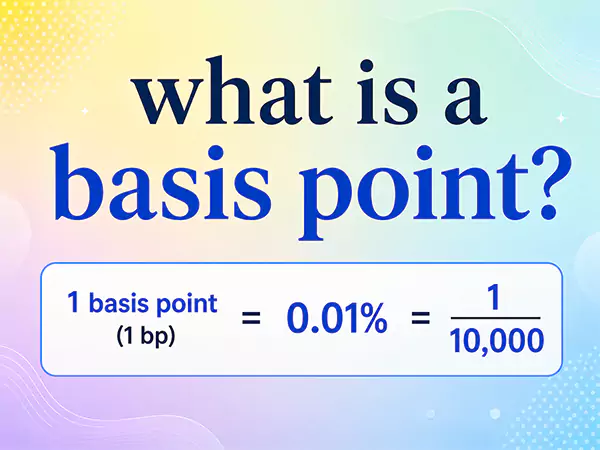
A basis point is a standard unit that measures changes in interest rates, yields, and fees. One basis point is equal to 1/100th of a percentage or 0.01%.
It can be written as “bp,” “bps,” and “bips” when you’re discussing rate fluctuations in financial markets. Most commonly, the bps calculator is used to describe minor fluctuations in stocks, bonds, and interest rates. Despite being a small unit, it makes a large impact on business finance, especially on investors.
Traditionally, some traders use the following terms to express large percentages.
1 basis point is equal to 0.01%. Here, I’ve listed the breakdown that shows the actual value and eases your calculation.
| Basis Points | Percentage Terms |
|---|---|
| 1 | 0.01% |
| 5 | 0.05% |
| 10 | 0.1% |
| 50 | 0.5% |
| 100 | 1% |
| 1,000 | 10% |
| 10,000 | 100% |
This highlights that a few basis points would affect the outcome. That’s why these calculations are important for investing for beginners.
Formula:
Basis Point / 100 = Percentage
For example, an interest rate is set to rise by 14 basis points as per the report. What’s the actual percentage of changing interest rates?
14 basis points / 100 = 0.14%
Formula:
Percentage x 100 = Basis Points
For example, a stock has fallen by 4.23% in the last two days. So, what’s the basis point of this fallen stock?
4.23% x 100 = 423 basis points
See, it’s easy to calculate both bps and percentages manually!
Also Read: Swiss Bank Account: How to Open, Benefits, Requirements, and More!
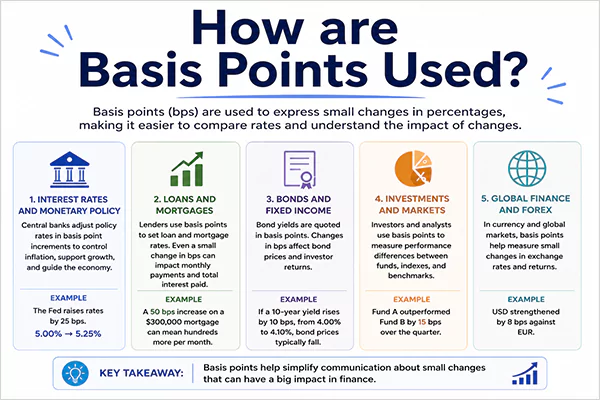
Basis points are used to express changes in interest rates. It completely erases your confusion about decimals, fractions, and percentages.
Let’s understand with an example in the following section!
“If your share value rose from 2% to 2.2%, you could say it rose 0.2% or 20 basis points. On the other hand, if your share value fell from 4% to 3.5%, you could say it fell 0.5% or 50 basis points. This highlights that bips make measuring easy and clear.”
You can easily measure the following financial instruments:
Professionals performing business valuation services also use changes in yields, discount rates, and market returns expressed in basis points when determining the value of a company or its assets.
Now, you’re all set to learn why investors use bps meaning mostly after understanding what is a basis point in the next section.
Investors can use basis points to mitigate confusion and describe changes in rates.
Here, I’ve mentioned two basic reasons to use the basis point.
Basis points eliminate confusion between absolute and relative percentage change.
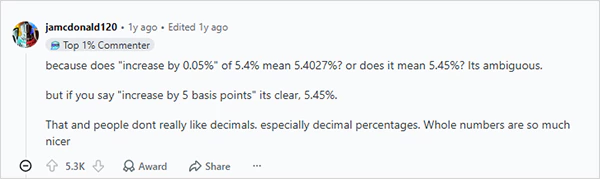
For example, on Reddit, a user asks, “Why do financial institutions say ‘basis points,’ as in ‘interest rate is expected to increase by 5 basis points’? Why not just say “0.05 percent”?
Another user stated that it’s ambiguous whether an increase by 0.05% either means 5.4027% or 5.45%. But if you say the interest rate is expected to increase by 5 basis points, it’s clearly 5.45%.
The user also said that people don’t like decimals or decimal percentages. That’s why whole numbers are used for better presentation.
As I mentioned earlier, bps meaning is most commonly used to describe fluctuations in interest rates, especially when the shift is smaller than one percentage point.
For example, the stock market falls by 0.25%, which you might see as a small adjustment. You can say it as the US stock market falls by 25 basis points.
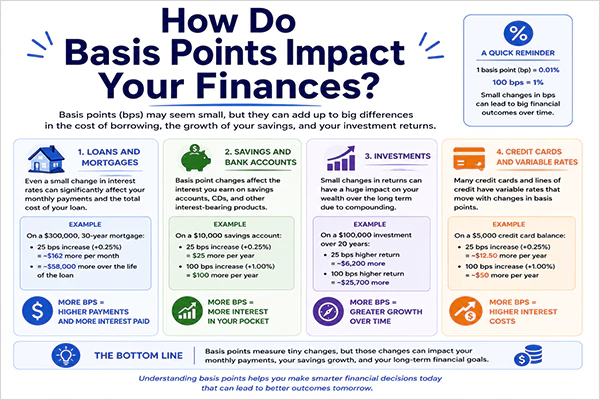
As you know, what is a basis point? It expresses changes in rates that directly or indirectly impact your finances.
Let’s face the fact! If you purchase a stock worth $100 and it rises by 50 basis points, it means that you will get higher returns. On the other hand, you will face a loss if the stock value falls by 50 bips.
This example shows you that a basis point can affect your finances in the following way:
For businesses, even small shifts in rates can influence cash flow planning, financing decisions, and budgeting strategies. This is one reason many organizations rely on CFO services to monitor financial trends and make informed decisions when interest rates change.
This has also highlighted the financial status of the economy, consumer spending, job market, and price of stocks and other securities.
Also Read: Standard Deduction vs Itemized Deductions: Which One is Better For You?
You can use the basis points in your real life when you are really into the investment market. Here are some examples where they are important!
Now, you understand what is a basis point and the reason to use it. It is just a standard unit to measure changes in interest rates, i.e., one basis point is equal to 1/100th of a percentage or 0.01%.
Even though it’s easy to calculate basis points and verify your financial status, you can hire a financial consultant or opt for investment services to get expert advice. This way, you can remove your burden and reduce your financial mistakes.
50 basis points is equal to 0.05%. It describes that the changes in interest rate are 0.05%.
People use basis points to eliminate the confusion between absolute and relative percentages. Instead of saying the rate goes up to 0.3%, they can say the rate will go up to 30 basis points.
300 basis points means that the rate change is 3%. One bp is equal to 1/100th of a percentage or 0.01%.
Yes, 200 basis points means 2%. In investment, 2% changes in rates are a lot when borrowing or selling a stock, bond, or equity.
Sources:
Basis Point – Investor.gov