

Marketing fundamentals play a crucial role in connecting customers and brands through posters, online ads, collaborations, and social media. It is the only way to increase brand awareness. But as a marketer or business owner, you should also understand the seven pillars and marketing models while aligning them with financial planning services like CFO services to ensure long-term growth
Here, I’ve compiled detailed information on the fundamentals of marketing, the 7Ps, marketing models, strategies, and how marketing helps businesses.
So, without any further ado, let’s dig deeper!
Key Takeaways:
- Marketing fundamentals include identifying real customers, building credibility, advertising, delivering products, pricing, and increasing sales, rather than just promotion.
- The 7Ps of the marketing mix are product, price, promotion, place, people, process, and physical evidence.
- Different types of marketing models are B2B, B2C, C2B, and C2C marketing. However, B2C is the most common and finest marketing model.
- Types of marketing strategies include digital marketing, print marketing, experiential marketing, influencer marketing, and affiliate marketing.

Marketing fundamentals are principles and strategies that guide businesses on how to sell products and services effectively. These fundamentals help businesses to understand customers’ needs, create value in the market, and build strong relationships with audiences, often supported by backend financial clarity such as cloud bookkeeping services.
Marketing fundamentals are not limited to advertising products or services; they help companies to attract, retain, and engage loyal customers for the long term. It ensures the following fundamentals of marketing:
On the whole, firms should never overlook the basis of marketing to expand their businesses and generate high revenue while maintaining compliance through sales tax services.
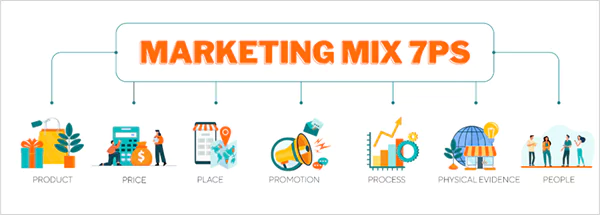
There are seven pillars of the marketing mix that guide businesses to take actions based on the following parameters.
Let’s take a look at these pillars for in-depth guidance:
The most important aspect of marketing is the product. Your product must be designed to satisfy end-user needs, while its long-term scalability can be evaluated using business valuation services. Your product must be designed to satisfy end-user needs.
If your product or service doesn’t have a USP (Unique Selling Proposition), meaning it cannot differentiate itself from competitors, no marketing strategy will help you. That’s why choosing a product always comes first in marketing fundamentals.
Moreover, your product must have creative, attractive packaging and presentation so customers can buy it easily. The packaging should also include instructions for use, specifications, and features.
After selecting a product or service, the next step is to decide its ideal and best price. You should determine the cost of a product by analyzing your product market, competitors’ prices, the cost of manufacturing, and studying the price structure.
In some cases, brands charge more than their opponents if they offer high-quality products to customers. This involves analyzing competitors, manufacturing costs, and value perception, often supported by financial insights from investment services.
Common Pricing Formulas:
- Markup Price: Cost + Markup = Price
- Margin Price: Cost/(1-Desired Margin%) = Price
Promotion is the best way to showcase your product or service to your targeted audience. It is one of the marketing strategies to communicate with customers. With the help of advertising, PR, and social media, customers get to know the uniqueness, benefits, purpose, and price of your product.
Nowadays, marketers implement an inbound marketing strategy to attract profitable customers through relevant content and a personalized experience.
In simple terms, the goal of promoting a brand is to increase visibility in the market and to convince customers to buy your product. Businesses also rely on structured financial planning like payroll services to support marketing campaigns and workforce execution.
Where do customers purchase your product? To answer this query, a “place” is necessary to display your product or service. The place refers to a physical store in a high-traffic area from which consumers can buy your product effortlessly.
Additionally, if you have an online business, your official website or app can be your place, which is the best way for digital marketing. Interestingly, operating an offline and online business can be proven highly profitable by reaching more customers.
It is important to consider that you must know the amount of inventory you need in your place based on demand. However, it should not be stocked more than the demand to avoid waste.
People are considered the members (staff, support teams, employees, and marketers) involved in delivering a product and building a brand reputation. Furthermore, these people build a strong marketing communication team to build good relationships with clients.
Converting customers into regular and loyal customers is the ultimate success for a business that increases sales. The best way to do this conversion is by providing the best possible experiences to your consumers, including good products and customer care services.
A certified customer provides feedback and recommends your products to other individuals, generating sales. This process continues in the long run and builds brand goodwill.
Ultimately, the process here means the delivery of products to its end-users. You should ensure that your team has built a seamless delivery process so that consumers receive their products on time and in good condition with premium packages.
In some cases, companies manufacture a high-quality product but forget to improve the delivery process, which de-influences customers and decreases sales. If you have an online business, this process highly impacts your business valuation.
Overall, the delivery process must be efficient, reliable, smooth, and fast from both the perspectives of customers and marketers.
The evolution of internet-based business has decreased sales in physical stores and increased online shopping. This results in shut-down stores and any physical evidence.
However, businesses should open at least one office or physical location to increase their reliability among customers. It is also important to prepare newsletters and pamphlets to increase consumer awareness of your brand.
There are four major types of marketing models: B2B, B2C, C2B, and C2C marketing. A company needs to choose one of these marketing models for delivering its products after analyzing market trends, resources, and other factors.
Here are the following types of fundamentals of marketing models in great detail.
B2B (business-to-business) marketing often involves selling products and services to other businesses rather than customers. It is one of the most famous marketing models, focusing on long-term relationships, generating leads, and providing value irrespective of high selling pressure.
Examples: Wholesalers, SaaS companies, and manufacturers.
B2C (business-to-consumer) marketing is one of the finest marketing models, where products and services are directly sold to end users or customers for personal use. Also, promotions and advertisements are mainly operated through retail businesses.
Examples: Airbnb, Nike, Amazon, Walmart, etc.
C2B (consumer to business) marketing is often used when an individual creates value for businesses by providing services, products, data, or statistics, opposite to the B2C model. Simply, this implies that customers sell services to businesses.
Examples: Freelancers, influencers, and reverse auctions.
C2C (consumer-to-consumer) marketing is a rare business model where one individual connects with another when they have common products or services. It includes the promotion through user-generated content, reviews, or word-of-mouth to leverage trust and indirectly benefit brands.
Examples: UGC, influencer collaborations, referral programs, and review sites and communities.
Let’s move towards the various categories of marketing strategies!
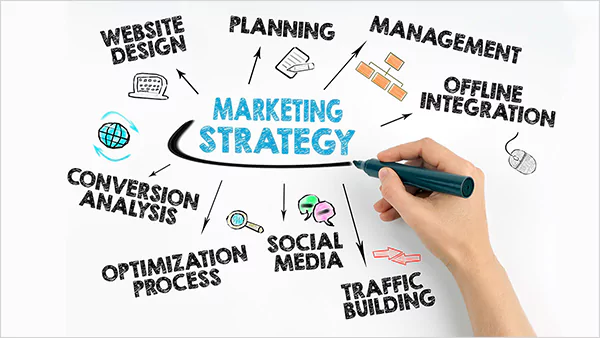
There are five types of marketing strategies, including digital marketing, print marketing, experiential marketing, influencer marketing, and affiliate marketing.
Here are the following types of marketing strategies you can follow to expand your business.
Digital marketing is the fastest-growing marketing strategy due to the increasing interactions of digital platforms. It includes the promotion of brands using social media apps, search engines, emails, SEO content, paid partnerships, paid advertisements, and websites to reach targeted audiences.
It is crucial for a company looking to expand its customer base to adopt digital marketing for greater reach and cost-effectiveness.
Print marketing is the oldest marketing strategy to promote brands, products, and services. This strategy uses tangible media such as newspapers, magazines, journals, pamphlets, brochures, business cards, direct mail, and billboards.
It builds high credibility and trust, with 82% of consumers finding it the most trustworthy marketing method. As a result, it is used to convey messages, brand deals, and discounts directly to consumers who are unfamiliar with online shopping.
Experiential marketing, also known as engagement marketing, is one of the most convenient strategies from the customer’s point of view. It encourages direct and interactive experience for the users with the intended products and services.
This means that customers can test the product before buying it. Through tactics like pop-up shops, events, festivals, workshops, and product demonstrations, brands will build emotional connections, enhance loyalty, and foster social sharing.
Influencer marketing is a new-age marketing strategy and is commonly popular on social media apps like Instagram and TikTok. In this strategy, companies collaborate with influencers, celebrities, and sports personalities with huge numbers of followers to advertise their products.
People follow these big personalities to get updates on the latest products and services, which may benefit brands by increasing the visibility of their goods. This will lead to gaining more customers through social media marketing.
Affiliate marketing is performance-based marketing where brands collaborate with influencers or celebrities to advertise their products; in exchange, they get a commission on each sale.
Essentially, it operates by using a unique tracking link through blogs, social media, or email, connecting a merchant, an affiliate, and a consumer, with payouts made per sale, click, or lead.
Marketing fundamentals help businesses in planning marketing strategies, conducting market research, creating targeted messages, measuring market performance, enhancing brand development, and navigating industry changes.
Here are the following important fundamentals of marketing in business.
These fundamentals of marketing (7Ps) provide a framework for setting goals and creating effective strategies. This begins with finding the target audience and understanding their needs. As a result, you can customize your product, distribution channels, pricing, and promotion to satisfy their needs, ensuring a higher profit.
Marketing fundamentals offer insights to help you conduct market research based on consumer preferences, market demand, and competitor analysis. The information gathered from this research helps businesses make informed decisions and minimize risk.
The basis of marketing allows you to create targeted messages to build strong connections with customers directly. By using information on marketing fundamentals, demographics, and psychographics, you can create communications that target your customers, improving engagement and loyalty.
Marketing fundamentals provide the foundational framework (KPIs, audience, and goals) to enable accurate tracking of return on investment (ROI), customer acquisition cost (CAC), and engagement, enabling continuous improvement.
These principles enhance brand development by increasing consumer awareness. This includes defining the brand’s unique selling proposition (USP), values, and missions. Effective branding or promotion makes the company stand out from competitors, leading to strong credibility and strong customer connections.
Marketing strategies are constantly evolving due to technological advances and consumer preferences. That’s why a strong grasp of the fundamentals of marketing helps businesses to analyze shifts in customer behavior, economic shifts, and new regulations, maintaining brand relevance.
The marketing era continuously shifted to digital methods using social media apps, websites, online platforms, and emails. Therefore, it is advised to understand marketing fundamentals deeply before starting a business and competing with your competitors strategically, with facts and figures.
Additionally, you can hire professional marketers and marketing services to build a roadmap for your business. It enhances your brand awareness, builds credibility, increases sales, and converts customers into loyal and regular consumers.
The fundamentals of marketing refer to creating brand value, identifying the targeted audience, building strong relationships, determining price, and selling products with a USP to stand out in the market.
The 5 C’s of marketing include:
The 7 pillars or 7Ps of marketing are the following:
Effective communication and storytelling skills are a must in marketing to reach your targeted customers and increase sales.
Sources:
Marketing and sales – U.S. Small Business Administration