

Future costs or obligations are often uncertain in terms of timing and amount. Companies use provision accounting to prepare for these obligations. It allows businesses set aside funds to anticipate future losses or costs, giving a more precise representation of a company’s financial status in its financial reports.
To understand what is provision accounting in-depth, you need to know the common examples of provision accounting, such as bad debts, warranties, taxes, depreciation, legal claims, and inventory write-downs. This early identification of such expected obligations can help businesses improve their financial planning, manage risk, and prevent overstating profits.
Knowing about provision accounting is vital for transparency, compliance, and effective financial management.
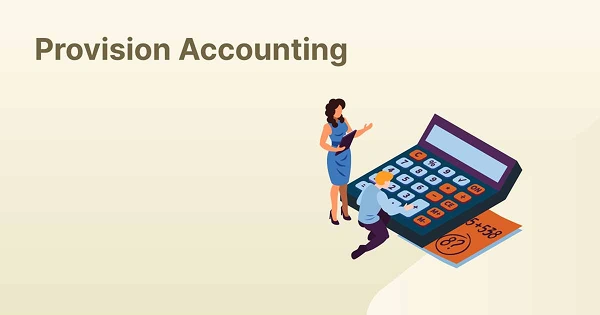
Provision accounting is the process of making estimates for future liabilities or costs that are recorded in a company’s book of accounts before payment becomes due.
A provision is made when:
In layman’s terms, provisions are an estimate of future expenditures that may be incurred but not predicted with certainty.
Typically, provisions are reported as:
This will give a more realistic financial position in the financial statements.
Provision accounting is based on the assumption of an estimated future liability, which is recorded in advance.
Step 1: Determine the Obligation
You must see if the future expense or liability is probable as a result of a past event.
Step 2: Estimate the Amount
The estimated amount is determined by applying the following to get an overall figure:
Step 3: Record the Provision
The estimated amount is noted:
Step 4: Make Adjustments to Provision
This provision is reviewed regularly and revised when necessary based on the estimates.
Step 5: Make a Settlement or Reverse a Provision
The provision is reduced or reversed once the actual cost is incurred.
This enables businesses to identify expenses properly in the appropriate financial accounting period.
Also Read: New York Business Entity Search: A Master Guide for Establishing a New Business in New York
Provision accounting is very important in financial reporting and business planning.
Provision accounting in general enhances the transparency and reliability of financial reporting.
The following section contains the provisions for the requirements.
There are certain conditions that must be fulfilled for the provision to be recognized.
Alternatively, if they are not fulfilled, the obligation could be considered a contingent liability.
There are various types of provisions in accounting, depending on what they anticipate and what they require in the future.
Read Next: How to Build Credit Fast: A Step-by-Step Guide for 2026
The provisions assist businesses in planning better for their financial needs. The following are examples of provision accounting.
Example 1: Bad Debt Provision
A company estimates that 5% of its credit sales are likely to become bad debts and makes a bad debt provision.
Example 2: Warranty Provision
An electronics firm predicts the future repair costs for products sold under warranties and factors those costs into its estimates.
Example 3: Legal Provision
A company that has been engaged in a suit estimates the probable costs for the settlement and makes a legal provision.
Example 4: Tax Provision
A business makes an estimate of the tax expenses for the year prior to finalizing the tax figures.
There are a number of advantages to using provision accounting, but there are also disadvantages, as it involves a great deal of estimation and judgment. Knowing the pros and cons means that companies can handle provisions more efficiently while ensuring proper financial reporting.
| Advantages | Disadvantages |
|---|---|
| Improves the accuracy of financial statements. | Estimates may not always be accurate. |
| Helps companies plan for upcoming costs. | Requires professional judgment. |
| Avoids unexpected financial shocks. | Excessive provisioning can have a negative impact on profits. |
| Facilitates improved financial planning. | May need adjustments on a frequent basis. |
| Enhances Transparency and Compliance. | Multiple provisions can be complex to manage. |
The key issues in proper provision accounting are regular monitoring, proper estimation, and compliance with accounting standards. Adhering to best practices ensures that businesses are more accurate with financial reporting, have a lower rate of error, and are more transparent.
Provision accounting can be challenging due to uncertainty, estimation, and evolving financial circumstances. There are many technical and practical hurdles that come with maintaining business finances when keeping accurate records.
Businesses should not underestimate or overestimate their provisions. It takes a keen eye for balance and judgment of all kinds when it comes to finances.
Provision accounting is an accounting method that involves recognition of liabilities and expenses before they are actually incurred. It supports businesses to create accurate financial reports, plan, and manage financial risks efficiently.
This will help companies to be more responsible when they estimate their future obligations, as they will have anticipated potential costs. Provision accounting is an accounting method that is based on estimates and uncertainty, but it is still an integral part of financial reporting and accounting in the modern world.
Read Next: Pending Transactions: Meaning, Processing Time, and Bank Balance Impact
Provision accounting is the process of creating an estimate of upcoming liabilities or expenses prior to them being paid.
The best example is the bad debt provision that estimates unpaid customer invoices.
Provision increases financial precision and planning and enables the business to plan for future commitments.
A provision is a part of expected liabilities, and a reserve is a part of profits that are set aside for future use.
Provision is shown as an expense in the income statement and a liability in the balance sheet.