

A balance sheet gives a picture of the financial health of a company at a given point in time. The balance sheets, unlike the income statements, indicate what the business owns, what it owes, and the value that is owned by the owners. Businesses often rely on professional guidance like financial consultant services to better understand these statements.
Whether the business is big or small, it is a crucial part of management to measure liquidity and financial stability for the investors and creditors. Many companies also use cloud bookkeeping services to maintain accurate and real-time financial data.
In this article, we will discuss the definition, aspects, format, and examples of a balance sheet. So grab your paper and pen and take notes!
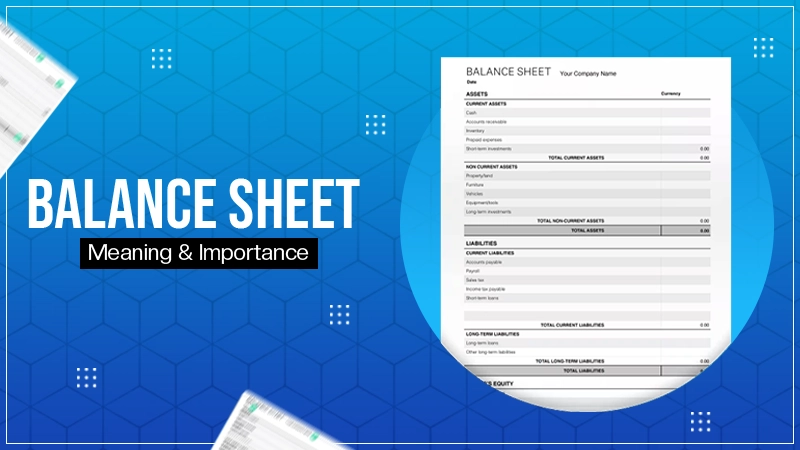
A balance sheet, or statement of financial position, is a list of a company’s assets, liabilities, and shareholders’ equity at a given time. This is meant to give a complete view of the financial position of the company. It is also helpful when businesses aim to build credit for financial growth
It is based on the basic accounting equation:
Assets = Liabilities + Equity
This equation makes resources of the company either funded by debt or ownership.
The three major elements of balance sheet accounts are: assets, liabilities, and equity. Businesses often integrate these with systems like payroll services for smoother financial operations.
The assets are the resources that the company has, but which are likely to bring about economic benefits in the future. Assets can be classified into:
Liabilities are debts that the company has to external parties. They are further classified into:
Equity represents the owner’s claim on the company’s assets after liabilities are deducted. These are commonly:
A balance sheet may be in various forms based on the business and mode of reporting. The structure is, however, the same and adheres to the accounting equation. Entrepreneurs exploring small business ideas often use such samples to understand financial planning.
These are two major forms in use:
The two formats make sure that the total assets are always equal to the sum of the liabilities and equity.
As an example, when assets of a company are valued at $100,000, they can be financed by liabilities of $60,000 and equity of $40,000. This balance provides financial reporting accuracy and facilitates transparency. This balance is especially important during processes like business valuation services.
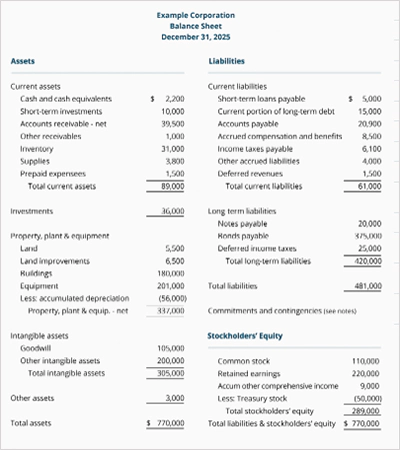
Here’s a balance sheet sample for better understanding:
A balance sheet evaluates the financial health of a business on a deeper level and is widely used by investors and creditors. Thus, it holds great significance; let’s discuss them here:
Reading a balance sheet correctly requires knowledge of the terms and knowing how it needs to be done to get the correct result.
In the preparation of a balance sheet, some mistakes are likely to be made by businesses, and this may impact the accuracy of the financial statements. The following are some of the typical errors:
Many businesses avoid these errors by using professional accounting services.
The balance sheet gives an overview of only a period, which can affect looking over the business operations in the past, leading to risk in financial health. Here are some more weaknesses that are associated with only relying on balance sheets:
A balance sheet is an important instrument of knowledge of the financial position of a business. It is very beneficial in equipping the owners, investors, and lenders with a clear picture of the assets, liabilities, and equity.
Key Takeaways:
A balance sheet is a financial statement that indicates things that a company possesses, like assets, what it owes, like liabilities, and what is left, like equity, at a given time.
These three elements are assets, liabilities, and equity. Assets are resources, liabilities are obligations, and equity is the share of the owner in the business.
A balance sheet assists in evaluating the financial strength of a company, gauging its liquidity and solvency, and assisting in the decision-making of investors, creditors, and management.
Source:
How to Read & Understand a Balance Sheet by Harvard Business School