

The balance sheet and income statement are the main financial statements that help businesses analyze their financial health, but the two differ in distinct ways. Determining the balance sheet vs income statement helps prepare them efficiently in accounting and supports better financial planning alongside services like cloud bookkeeping services.
Therefore, as a business owner, investor, or manager, you should acknowledge these statements thoroughly. This guide covers the difference between the balance sheet and income statement, definition, components, examples, pros and cons, and similarities while also aligning with broader financial strategies such as CFO services.
So, stay adherent to this article!
A balance sheet shows a company’s financial health, including assets, liabilities, and equity at a specific point in time. On the other hand, the income statement represents a company’s financial performance by adding income and expenses quarterly or annually, which is essential when evaluating investment services.
Still, you are perplexed about the difference between balance sheet and income statement; let’s take a look at this breakdown table.
| Feature | Balance Sheet | Income Statement |
|---|---|---|
| Purpose | It shows financial health and net worth. | It highlights profitability and performance. |
| Timeframe | Provide information on a specific date. | Offer information for a given period, usually a month, quarter, or year. |
| Items Included | Assets, liabilities, and equity. | Revenue, expenses, profits, and losses. |
| Core Formula | Assets = Liabilities + Equity | Net Income = Revenue – Expenses |
| Main Components | Cash, inventory, debt, and equity. | Revenue, COGS, expenses, profit |
| Focus | Liquidity and solvency | Operational efficiency |
| Alternate Name | Statement of financial position | Profit & Loss Statement (P&L) |
| Format | Usually has two sides, with assets and liabilities. | Typically lists revenue and expenses followed by net profit and loss. |
| Usage | Investors and lenders use it to determine the availability of assets for collateral. | Management, investors, and shareholders use it to assess the performance and prospects. |
After acknowledging income statement vs balance sheet, skim through the content below to learn about these statements deeply, especially if you are exploring growth opportunities like small business ideas.
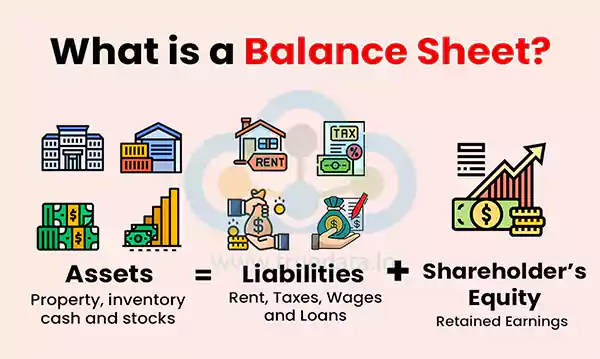
A balance sheet is a picture of a company’s financial health that includes assets, liabilities, and shareholders’ equity at a specific point in time. Companies use it to determine the amount of working capital they actually have and the money they owe, which is crucial for compliance tasks such as sales tax services..
Moreover, the balance sheet represents every single transaction, the amount invested, assets required, and debt accumulated in a single statement. This provides financial insights to companies to make informed decisions about assets, debts, and business operations, often supported by business valuation services.
It is important to note that an organization should update its balance sheet every month to get the most updated snapshot of its financial position.
The major components of the balance sheet are assets, liabilities, and equity. Therefore, it follows the core formula:
Assets = Liability + Shareholders’ Equity
Here are the following details of its components:
Assets are what a company owns. This includes cash, inventory, equipment, accounts receivable, debts, physical properties, trademarks, patents, and copyrights.
This section is divided into two sections: Current Assets and Non-Current Assets. Current assets are easily converted into cash within a year (inventory, cash, accounts receivable). On the other hand, non-current assets are not convertible into cash (property, plant, and copyrights).
Liabilities are the things that a company owes. This includes financial obligations, debts, loans, bills, taxes, accounts payable, wages, and underfunded pension plans, which may also involve regulatory considerations like international tax services..
Similar to assets, this section is also divided into two sections: Current Liabilities and Non-Current Liabilities. Short-term debts are those a company expects to pay within a year (accounts payable and accrued wages), while long-term debts are due after one year (long-term loans and debts).
Shareholders’ equity refers to the net worth of a firm. This section tracks how much money investors invested. It is the remaining earnings if all assets are sold and all debts are paid off, representing the owner’s stake.
Note: While preparing a balance sheet, the total of all assets and all liabilities should be equal.
Let’s take a look at the in-depth example of a balance sheet.
For example, here are the assets, liabilities, and equity of Goowell Pvt. Ltd. as of January 31, 2026.
| Assets | Amount | Liabilities | Amount |
|---|---|---|---|
| Current Assets | Current Liabilities | ||
| Cash & Cash Equivalents | $1,50,000 | Accounts payable | $45,000 |
| Accounts Receivable | $80,000 | Wages Payable | $12,000 |
| Inventory | $120,000 | Current Portion of Long-term Debt | $20,000 |
| Prepaid Expenses | $10,000 | Interest Payable | $3,000 |
| Total Current Assets | $360,000 | Total Current Liabilities | $80,000 |
| Non-Current Assets | Non-Current Liabilities | ||
| Property, Plant & Equipment (Net) | $500,000 | Long-term Debt | $300,000 |
| Intangible Assets (Goodwill) | $50,000 | Deferred Tax Liabilities | $40,000 |
| Total Non-Current Assets | $550,000 | Total Non-Current Liabilities | $340,000 |
| Shareholders’ Equity | |||
| Common Stock | $200,000 | ||
| Retained Earnings | $290,000 | ||
| Total Equity | $490,000 | ||
| TOTAL ASSETS | $910,000 | TOTAL LIABILITIES & EQUITY | $910,000 |
As I mentioned earlier, the balance sheet highlights what a company owns, its debts, and shareholders’ equity to give real insights into its financial position. However, it doesn’t show the net income or cash flow in a business, which is why businesses also rely on structured systems like payroll services.
That’s why you need to acknowledge both the drawbacks and the benefits of a balance sheet.
| Advantages | Disadvantages |
|---|---|
| It offers a quick picture of the overall debt and how much cash a company has, including all assets and liabilities, to determine the amount of risk. | It shows the reflection of one-time financial position at the end of the month or year, and does not represent the challenges throughout the time period. |
| Showing investors and stakeholders financial health and the ability to repay debts as a way to raise capital and expand the business. | Assets are often recorded at their purchase value or book value, not their current market value. As a result, it can overstate or understate the financial health. |
| Managers can analyze the number of assets and liabilities to create financial ratios such as debt-to-equity and quick ratios. This helps them to improve their financial health and compete with competitors. | A balance sheet does not show profitability, net income, or cash flow of a company. Therefore, management needs an income statement alongside it. |
| When comparing balance sheets across multiple time periods, it can identify growth in assets and improvement in equity. |
After acquiring knowledge on the balance sheet vs income statement and what a balance sheet is, you are all set to uncover information on the income statement, especially when aligning financial reporting with compliance requirements such as payroll tax.
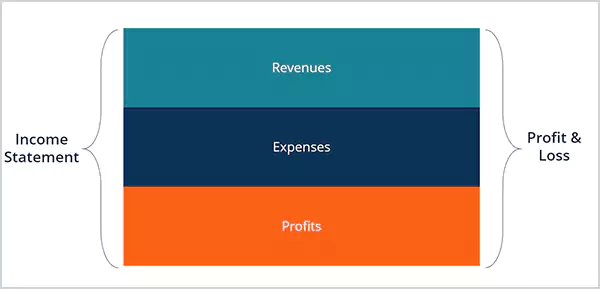
An income statement is also known as a profit and loss (P&L) statement. It shows the financial performance of a company through quarterly or annual reports. It adds total revenue and gains and subtracts them from expenses and losses to show whether a company made a profit or not.
Apparently, if the total revenue is greater than total expenses, the business made a profit during a specific period. However, if the total expenses are greater than the total revenue, the business incurs a loss during that period.
In simple terms, businesses can use an income statement to calculate their profits and losses and find areas of improvement.
The major components of the income statement are revenue, expenses, gains, and losses. Therefore, it follows the core formula:
Net Income = Revenue – Expenses
Let’s take a look at these components thoroughly:
Revenue includes money earned from the sale of products, interest from capital, lending, and royalties, fees earned from business services, and other earnings, which can also be influenced by strategies like marketing fundamentals.
Expenses include the cost of goods sold (COGS), administrative expenses, research costs, rent, salaries, utilities, interest payments on debts and loans, material costs, and wages that were generated by the operating revenue.
Money earned from on-time sales outside the business operations, such as selling equipment, property, investment, and other long-term assets that a company owns at a value higher than the book value.
The opposite of gains and represents non-operating decreases in equity. This means selling an asset, inventory, or property at a lower price than the book value.
You can prepare the income statement starting with total revenue and subtracting various costs to calculate net income.
Let’s take a look at the following detailed example of an income statement.
For example, here are the revenue, expenses, gains, and losses of an Expert Merchandising Corporation for the year ended December 31, 2025.
| Item | Amount | Subtotal |
|---|---|---|
| Sales Revenue | $1,000,000 | |
| Cost of Goods Sold (COGS) | ($600,000) | |
| Gross Profit | $400,000 | |
| Operating Expenses | ||
| Salaries & Wages | $100,000 | |
| Rent & Utilities | $50,000 | |
| Marketing & Advertising | $20,000 | |
| Depreciation Expense | $10,000 | |
| Total Operating Expenses | ($180,000) | |
| Operating Income (EBIT) | $220,000 | |
| Non-Operating Items | ||
| Interest Expense | ($5,000) | |
| Gain on Sale of Asset | $2,000 | |
| Income Before Taxes (EBT) | $217,000 | |
| Income Tax Expense (e.g., 25%) | ($54,250) | |
| NET INCOME | $162,750 |
“Every coin has two sides.” The income statement helps businesses to analyze operational efficiency and the company’s overall performance, but it also lacks in showing the company’s cash on hand.
Hence, you should understand both the advantages and disadvantages of an income statement.
| Advantages | Disadvantages |
|---|---|
| It helps the executives or owners to determine the overall revenue and expenses to calculate the company’s performance. | If market conditions change, it may not predict the future expenses and income of a business, based on past period statements. |
| Allowing investors to see the profitability or losses of a company from history to decide whether to invest in a business or not. | It does not show liabilities such as debts, interest paid, wages owed, and loans in a statement. Hence, you should have a balance sheet alongside it. |
| It offers a consistent report or insights for comparing performance against other competitors in the market. | It is based on accrual accounting, meaning the reports show the profitability of a company if it has no actual cash on hand. |
| Managers can cut down the cost of goods sold (COGS) and other operating expenses, if possible, with the help of the income statement. | |
| It enables management to set pricing, plan budgets, and forecast future revenue trends. |
Though the balance sheet and income statement are different from each other, they are linked to each other and have some similarities. Both the balance sheet and income statement are financial reports that give a clear picture of a company’s financial position and are often used together in advanced financial analysis like evaluating top hedge funds.
Here are the following common items in both the income statement and balance sheet.
Understanding the balance sheet vs income statement helps you to figure out how to prepare both financial statements. Simply, the main purpose of a balance sheet is to show current assets at a particular time, while the income statement represents revenue, gains, expenses, and losses annually or quarterly.
In case you find it perplexing to manage your financial reporting accurately, you can hire accounting services or professionals. This is particularly helpful when dealing with compliance requirements such as New York business entity search. The right guidance helps you improve your efficiency and business goals.
A balance sheet reports assets, liabilities, and equity to show a company’s financial health. On the other hand, the income statement shows revenue, gains, expenses, and losses to assess financial performance.
An income statement is prepared first in accrual accounting because it shows profit and loss, which is required for equity in a balance sheet.
The three main financial statements are a balance sheet, an income statement, and a cash flow statement.
Yes, the income statement and profit and loss statement are the same. There is no functional difference between them.
Sources:
Beginners’ Guide to Financial Statement – U.S. Securities and Exchange Commission