


In business, you should have a record of all your income and expenses for financial data. This indicates that financial accounting is more than just bookkeeping. You need to identify which item has to be debited and credited. That is why the golden rules of accounting are essential for accurate entries.
As a business owner or accountant, you should explore this article to understand how the three golden rules work. You can discover types of accounts, examples, practical entries, advantages, and common mistakes to avoid.
So, stay adherent to this article!
The three golden rules of accounts help you record every financial transaction in a double-entry bookkeeping system. They also govern how to measure business finance accurately. Maintaining accurate financial records through cloud bookkeeping services can help businesses organize transactions and keep their financial information up to date.
Here is the breakdown table of accounting rules:
| Account Type | Golden Rules | What to Debit | What to Credit | Example |
|---|---|---|---|---|
| Real Account | Debit what comes in, credit what goes out | Asset received | Asset given out | Purchased furniture for cash: Debit Furniture and credit Cash |
| Personal Account | Debit the receiver, credit the giver | Receiver | Giver | Paid $100 to Belmont: Debit Belmont and credit Cash |
| Nominal Account | Debit all expenses and losses, credit all incomes and gains | Expenses and Losses | Incomes and Gains | Paid rent $400: Debit rent and credit cash |
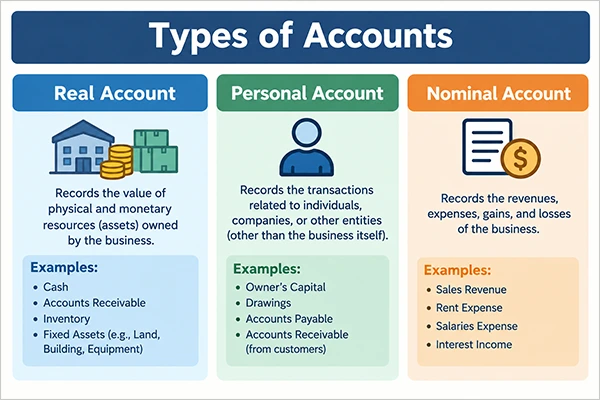
There are three types of accounts in accounting: real accounts, personal accounts, and nominal accounts.
Understanding types of accounts is important because accounting rules are aligned with these three distinct accounts. Accurate classification also supports financial reporting and helps businesses assess their financial position when preparing for CFO services.
A real account deals with transactions related to tangible and intangible assets and liabilities. Tangible assets include furniture, land, buildings, machinery, etc., while intangible assets include goodwill, copyrights, and patents. Liabilities are accounts payable, notes payable, and retained earnings. Real accounts appear on the balance sheet, such as the furniture account. Businesses can use these records to support financial analysis and understand the value of their assets through business valuation services.
A personal account records transactions related to real persons, companies, and associations. It includes customer, supplier, bank, and capital accounts. You can record transactions in the journal that cover creditors, outstanding expenses, and income.
Here are the subcategories of a personal account:
A nominal account records all business income, expenses, profit, and losses. The transactions are temporary and recorded only for one fiscal or accounting year. As a result, the balance resets to zero and restarts the following fiscal year, unlike a real account.
For example, salary revenue, interest revenue, rent expense, depreciation expense, gain on sale of assets, and loss on sale of assets. Recording employee salaries and other payroll expenses correctly is also important when managing business finances through payroll services.
For example, salary revenue, interest revenue, rent expense, depreciation expense, gain on sale of assets, and loss on sale of assets.
Hope you got it! Let’s move forward towards the golden rules!

The three golden rules of accounting are:
Let’s take a look at these golden rules of accounting in great detail!
This rule applies to real accounts, which deal with assets and liabilities. It means that whenever the asset comes into the business, it’s debited, and when the asset leaves the business, it’s credited.
Let’s understand with an example:
A company purchases $1,000 worth of office furniture as a physical asset and pays for it immediately on 1st September 2026. The transaction will be recorded as follows:
| Date | Account | Debit | Credit |
|---|---|---|---|
| 1st September 2026 | Furniture A/c | $1,000 | |
| To Cash A/c | $1,000 | ||
| (Being furniture purchased for cash) |
This golden rule applies to all personal account transactions. It records transactions where value is exchanged between two parties. This means that when someone receives payment, it’s debited, and when someone gives money, it’s credited.
For example, a business owner pays $500 rent to Mr. John (a landlord) in cash on 7th August, 2026. The transaction takes place as follows:
| Date | Account | Debit | Credit |
|---|---|---|---|
| 7th August, 2026 | Mr. John/Rent A/c | $500 | |
| To Cash A/c | $500 | ||
| (Being rent paid to Mr. John in cash) |
One of the last golden rules for accounting is related to nominal accounts. This rule ensures that all expenses and losses are debited and all incomes and gains are credited in bookkeeping.
It is also related to the company’s capital. In accounting, capital is treated as a liability. Income and gains increase the capital, and that’s the reason they are credited.
For example, a company paid $10,000 in salaries to employees in cash, which reduces capital on 1st September 2026. So, you can record the transactions like this:
| Date | Account | Debit | Credit |
|---|---|---|---|
| 1st September 2026 | Salary A/c | $10,000 | |
| To Cash A/c | $10,000 | ||
| (Being paid a salary to employees in cash) |
Also Read: Income Statement: What Is It, Main Parts, and What Investors Should Keep in Mind
Let’s understand the nature of how the golden accounting rules work.
Here is the following list of financial transactions:
Examples:
1. The owner invests $50,000 cash to start the business on 1st April 2026.
Golden rule applied:
| Date | Account | Debit | Credit |
|---|---|---|---|
| 1st April 2026 | Cash A/c | $50,000 | |
| To Owner’s Capital A/c | $50,000 | ||
| (Being cash brought to the business to raise capital) |
2. Buys a delivery van for $15,000 cash on 3rd April 2026.
Golden rule applied:
| Date | Account | Debit | Credit |
|---|---|---|---|
| 3rd April 2026 | Delivery van A/c | $15,000 | |
| To Cash A/c | $15,000 | ||
| (Being a delivery van purchased for cash) |
3. Purchases $4,000 of inventory on credit from Smith Wholesalers on 5th April 2026.
Golden rule applied:
| Date | Account | Debit | Credit |
|---|---|---|---|
| 5th April 2026 | Purchase A/c | $4,000 | |
| To Wholesalers A/c | $4,000 | ||
| (Being goods purchased on credit from Smith Wholesalers) |
4. Sells goods for $6,000 cash on 10th April 2026.
Golden rules applied:
| Date | Account | Debit | Credit |
|---|---|---|---|
| 10th April 2026 | Cash A/c | $6,000 | |
| To Sales Revenue A/c | $6,000 | ||
| (Being goods sold for cash) |
5. Pays $1,200 cash for office delivery on 11th April 2026.
Golden rule applied:
| Date | Account | Debit | Credit |
|---|---|---|---|
| 11th April 2026 | Electricity Expense A/c | $1,200 | |
| To Cash A/c | $1,200 | ||
| (Being electricity bill paid in cash) |
6. Pays Smith Wholesalers $2,000 cash towards the debt on 15th April 2026.
Golden rules applied:
| Date | Account | Debit | Credit |
|---|---|---|---|
| 15th April 2026 | Smith Wholesalers A/c | $2,000 | |
| To Cash A/c | $2,000 | ||
| (Being cash paid to Smith Wholesalers on account) |
Golden rules of accounting help in recording transactions accurately, provide evidence for legal concerns, assist with tax-specific matters, and support the business budget.
Here are the advantages of applying the golden rules of accounts.
Golden accounting rules make sure that your financial transactions are recorded in the right accounts. They help you compare business losses and profits year over year. Accurate bookkeeping also provides the financial records needed to plan investment services and evaluate business opportunities.
When you follow basic accounting rules and maintain bookkeeping entries, it’s easy to avoid legal allegations. You can also use these transactions as solid evidence of your business analysis.
Lack of proper accountability can lead to tax penalties. That is why you should follow accounting rules to record financial statements and prevent your business from tax shortfalls. Businesses operating across borders may also need professional guidance on international tax services to understand their tax obligations.
Recording year-over-year financial transactions that are aligned with the golden rules of accounting and basic accounting can help you identify your business position. It also builds a strong pillar for success and helps you gain more profitable projects.
Also Read: What Does Accounts Payable Mean? – Example, Best Practices, and More
You should avoid errors like double-entry, identifying accounts, mixing assets, and omitting asset depreciation.
Let’s take a look at these common mistakes to avoid in accounting.
Golden rules of accounting are necessary to ensure accuracy in financial transactions. These accounting rules can make your double-entry bookkeeping relevant and classified.
They help you make journal and ledger entries for further accounting. This indicates that you must know the golden rules of accounts to compare your business profits and losses and make informed decisions.
If you find it difficult to understand or record, you can opt for Accountance cloud bookkeeping services. Their services offer accurate insights, GAAP-aligned rules, and reduce errors.
The three golden rules of accounting are the following:
The three types of accounts are the following:
The 7 journal entries are:
Common accounting mistakes include double-entry errors, mixing personal and business transactions, and failing to identify types of accounts.
Sources:
- Golden Rules of Accounting With Examples – IFDA Institute