


An income statement is one of the most useful financial statements for determining if a business is actually generating profits. It combines all the income, expenditure, costs, and other gains or losses of a company for a given time span. It shows you the flow of numbers generated by the business from the money to profit, giving you a better idea of how the business is doing.
The understanding of how to read an income statement can be useful for investors and others who invest in companies. We’ll discuss all about it here, so keep on reading!
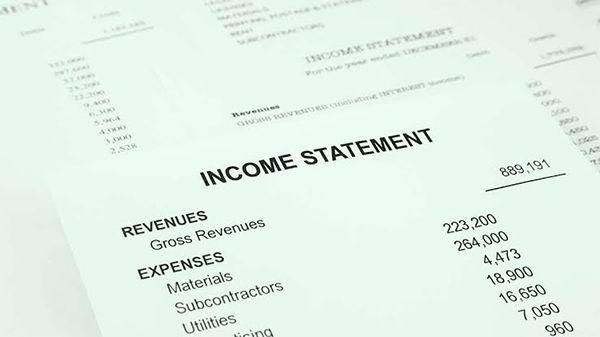
The income statement is a financial statement that provides details of the company’s financial performance within a specific timeframe, such as a quarter, six months, or over a fiscal year.
An income statement differs from a balance sheet in that it reports the revenue and expenses of a company over a period of time. It can also be referred to as the profit and loss statement (P&L).
The simple idea of the statement is that:
Revenue – Expenses + Other Gains/Losses = Net Income
If the result is negative, the company has a loss. When expenses and losses are higher than revenue and gains, then the company reports a loss.
The company’s sales don’t indicate whether it’s making money.
Suppose there are two businesses that produce $10 million in revenue. The first one costs $6 million to run, and the second costs $9.5 million to run. They sell the same, but their profitability is vastly different.
This is why an income statement is useful. It allows you to see the big picture beyond the revenue and understand what it’s going to take to earn that revenue and what will be left over as profit.
The income statement can provide clues to a person assessing a company about:
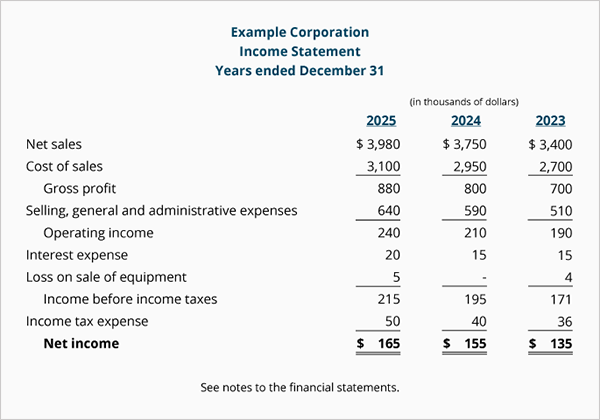
While all companies can present their statements differently, most of them have familiar categories.
Revenue is the income that a business generates from selling its goods or services. The first line of the income statement is also sometimes referred to as sales, net sales, or total revenue.
A software company may be a revenue generator from subscriptions, for example, while a retailer may be a revenue generator from selling merchandise.
Don’t only consider the size of the company’s revenue when analyzing a company. Take note of the rate of revenue growth and its regularity.
A business that is growing sales by 20% but expenses by 30% could be failing to become more profitable.
Also Read: Invoice Payment: What It Is, Its Importance, and Payment Methods
Cost of goods sold (COGS) is the direct expense incurred to manufacture the goods or services that brought in revenues.
This can include materials and direct production costs for a manufacturer. It typically represents the cost a retailer paid to acquire the merchandise it sells.
Gross profit is revenue – COGS:
Gross Profit = Revenue − COGS
Gross profit gives a quick indication of the company’s profitability after taking into account the direct costs involved in its production or acquisition of the goods and services it sells.
Investors can go a step further with gross profit and measure it as gross margin.
Gross Margin = Gross Profit / Revenue X 100
If a company generates $1 million in revenue and $600,000 in COGS, how much profit does the company make? The gross profit is $400,000, and their gross margin is 40%. The increase in gross margin can reflect a high increase in price, better product economics, and better efficiency.
A falling margin may be related to higher production costs, pricing pressures, or the transition to less profitable products.
This is an issue, and so changes in margin should be researched rather than taken at face value.
Once gross profit has been calculated, the income statement details other costs needed to operate the wider business.
These can include:
These costs aren’t necessarily tied directly to producing one particular product, but they are important to keeping the company operating.
Even though a business may enjoy high gross margins, it can lose money because of high operating costs.
After gross profit, operating income is the main part of the profit after operating expenses.
Operating Income = Gross Profit − Operating Expenses
One of the most important uses of operating income is to look at how profitable a company is with regard to its core business activities before certain factors like interest and income taxes.
It can then give you insight into whether the business model is successful or not.
If a company is showing an increase in revenue and a decrease in operating income, its operating costs may be increasing, and it could be trimming growth out of its bottom line.
A business can also make profits or losses that are not related to its business.
A company could, for example:
Many items may not necessarily be correlated with the company’s core business but may impact its profit at the end of the day. That’s why it’s important to separate the operating performance from its overall bottom line.
Generally, the income tax expense is usually recorded before net income is calculated.
The tax amount is dependent on a number of factors such as taxable income, jurisdiction, tax credits, etc., and can vary significantly for different companies. The tax expenses reported by a company are not necessarily the total result of applying the tax rate to each dollar of revenue.
At the end of the income statement comes net income.
It is the amount of money that the firm has left after it has deducted its expenses, interest, taxes, and other costs listed on the statement and, if applicable, the taxes it has incurred on the profits it earned.
In simple terms:
Net income is calculated as the total income and gains minus the total expenses and losses.
If it’s negative, the company incurred a net loss.
Net income is a key number but not the only number to look at. A one-time gain can result in a company’s high net income even if its operations are not exceptionally successful.
The mistake that is often made is that people think the cash flow statement, balance statement and income statement are synonymous, but they are not.
Generally, an income statement is prepared using accrual accounting, which allows income to be recognized and incurred, not necessarily when cash is collected or paid.
For example, a firm might sell a product today and permit the purchaser to pay for it in 60 days. The company can book the revenue before receiving cash.
The primary emphasis of the cash flow statement is on the flow of cash.
Therefore, when assessing a business, the income statement should be used in conjunction with both the balance sheet and the cash flow statement and should not be used as the only source.
Simply looking at an income statement can give you a false sense of security, and yet it may have warning signs.
You must look out for:
It is also useful to compare a company’s results with competitors.
An income statement provides you with a financial story in numbers: how much money a company made, how much it needed to run, and how much was left over.
When individuals are considering where to invest, the best way is not to go for the highest income or largest net income. Examine the relationships among revenues, costs, margins, revenues and costs, and net income, and compare the amounts from one period to another.
We have covered everything about the income statement in this blog, and we hope this information helps you out!
Read Next: What is Single Touch Payroll? – Its Benefits, Common Mistakes, and Reporting Process
The income statement is a financial statement that indicates a business’s income and losses for a period of time. It assists in establishing whether a business made a profit or a loss in that time.
The usual income statement components are revenue, cost of goods sold (COGS), gross profit, operating expenses, operating income, interest and other income/expenses, taxes, and net income. By looking at these factors, investors can gain insight into a company’s profitability and financial performance.
The income statement may be produced monthly, quarterly, or yearly, depending on the requirements of the business. Items may also be released for the public to view, including quarterly and annual income statements that will allow investors to assess the changes in revenue, costs, profitability, and financial performance of the company.