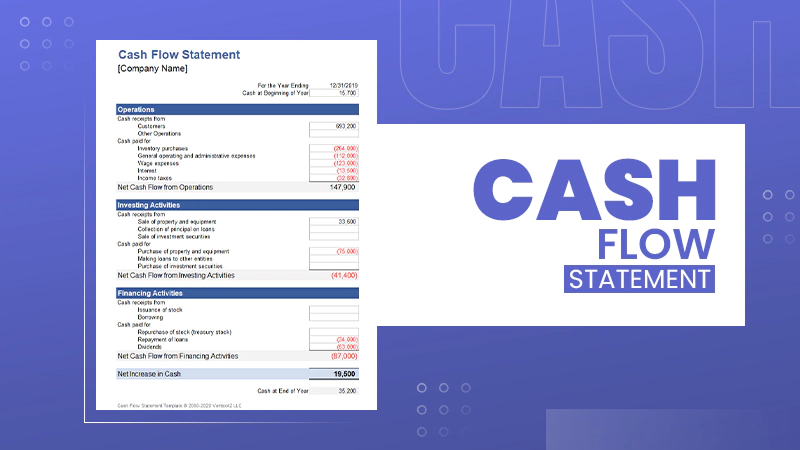


How to keep track of your business cash flows? This problem has only one solution – “cash flow statement.” It keeps a record of all cash inflows and outflows of a company over a period.
This helps business owners, investors, or shareholders to analyze the company’s financial position. So, if you’re among them, you should read this article for deep insights.
Here, you can learn components, steps to prepare it, methods, and examples. Let’s go ahead!
Key Takeaways:
- A cash flow statement helps business owners to estimate the financial strength of a company.
- It consists of three components: operating, financing, and investing activities.
- Preparing a cash flow statement can be done through direct or indirect methods.
- A positive statement of cash flows helps owners to attract new investors.
A cash flow statement tracks the cash inflow and outflow of the company over a specific period. It is used to estimate how a business generates cash to fund future growth and other operations.
Unlike the profit and loss statement, it covers the flow of money in a business through operating, investing, and financing activities. This helps shareholders assess the company’s financial position and ability to deal with obligations.
For example, if an organization receives a cash payment from a client or pays interest on a loan, both transactions are recorded in the statement.
A cash flow statement includes three main components: operating, investing, and financing activities. These sections describe the type of transaction recorded in it.
Let’s take a look to understand these components!
Operating activities include the cash flowing in and out of a company as it runs the business. It helps to determine whether the organization generates enough cash without external financing.
You should remember that positive operating cash flow indicates that the business can cover expenses. Meanwhile, a negative flow affects the working capital.
This section includes all activities related to long-term investments. It also includes the company’s investment in bonds and stocks. This affects the company’s growth and liquidity.
But frequent asset sales can lead to financial distress in order to generate more cash. So, you should balance your investing activities.
The financing activities track cash inflow and outflow from investors and lenders. It shows how an organization raises and repays capital through financing.
But excessive debt can lead to financial risk if you don’t have revenue sources.
Also Read: How to Read a Credit Report? How to Get Your Credit Report and Fix Errors?
You can calculate a cash flow statement either by the direct or indirect method. Both methods generate the same result but require different information and structure.
Here are the difference of direct and indirect methods in great detail.
The direct method lists all cash paid or received from operating activities. It is more complex and requires more tracking. In this method, it doesn’t start from net income.
For example,
The indirect method starts with the net income from the income statement. It also presents non-cash items and changes in working capital. This method is simple and commonly used by business owners.
For example,
You can prepare a cash flow statement by calculating all cash transactions and reviewing them.
Here are the simple and detailed steps on how to prepare a cash flow.
Step 1: Collect all financial information
First, you should have data such as net income, non-cash expenses, assets and liabilities, and bank statements.
Step 2: Choose a method to calculate
Now, you have to select between the direct and indirect methods according to your preferences and business standards.
Step 3: Calculate operating activities
If you are using the indirect method, you should start with the net income, non-cash expenses, and adjustments. But in the direct method, you can record actual cash inflow and outflow.
Step 4: Calculate investing activities
Next, you can calculate cash flow from long-term investments. It includes capital expenditure, asset sales, loan collections, new investments, and buying securities.
Step 5: Calculate financing activities
After this, you can compute transactions related to issuing stocks and borrowing funds. For example, debt repayments, paying dividends, and buying back stock.
Step 6: Add all activities
After calculating all activities, add them to determine net change in cash. But you should ensure that the ending cash balance matches the balance sheet’s cash account.
Step 7: Review and analyze
Now, you can review all your calculations to ensure that the outcome is correct. The positive cash flow highlights that the company’s financial stability is strong and it meets obligations easily.
Also Read: How to Start a Small Business? 11 Step-By-Step Process to Start Your Business Career
You can conduct business analysis through the statement of cash flows. It helps you gain valuable insights into a particular company before investing in it.
Here are some basic tips for better understanding.
You can take a look at the detailed example of how to prepare a cash flow statement.
For example, Wellgiver Pvt. Ltd has operating, financing, and investing activities. Let’s record them in the statement of cash flows.
| Cash flows from operating activities | |
| Net income | $150,000 |
| Adjustments for non-cash items | |
| Depreciation expense | $25,000 |
| Changes in working capital | |
| Increase in accounts receivable | ($10,000) |
| Decrease in inventory | $8,000 |
| Increase in accounts payable | $5,000 |
| Net cash from operating activities | $178,000 |
| Cash flows from investing activities | |
| Purchase of equipment | ($50,000) |
| Sale of old machinery | $12,000 |
| Net cash from investing activities | ($38,000) |
| Cash flows from financing activities | |
| Proceeds from bank loan | $40,000 |
| Cash paid for dividends | ($20,000) |
| Net cash from financing activities | $20,000 |
| Cash balance at end of year | $160,000 |
Note: This example is for informational purposes only.
A cash flow statement is important to track cash flows in the company. Let’s take a look at these points to understand why it is important in a business.
A cash flow statement plays a vital role in assessing the company’s financial position. The three components- operating, investing, and financing activities always give insights into all cash transactions.
If you find preparing and reading the cash flows difficult, you can hire a financial expert or accountant. Their expertise can help you improve your business operations and contribute to expansion.
Also Read: Invoice Payment: What It Is, Its Importance, and Payment Methods
A cash flow statement includes operating, financing, and investing activities. These categories show cash movements in a company and the balance at the end of the year.
Four rules of a cash flow statement are the following:
Red flags for the company are regular negative operating activities, frequent asset sales, and a decrease in working capital.
When the company has more cash inflow than cash outflow, it is considered a good cash flow. This means that the organization can meet expenses and obligations easily.
Sources:
- How to Prepare a Cash Flow Statement – Harvard Business School
- Understanding Cash Flow Analysis – IOWA STATE UNIVERSITY