


According to the IRS, the bonus tax rate is flat at 22% on the first $1 million. If the amount exceeds it, it is at 37%. This means that when you get bonuses, you should calculate your tax liability and ensure accurate reporting through reliable payroll services.
But how are bonuses taxed? To help you, I’ve compiled detailed information on types of bonuses, examples, states’ total tax withheld, and tips to reduce your tax bill in this article.
Let’s go ahead!
A bonus tax rate is the withholding amount from the employees’ bonuses. According to the IRS (Internal Revenue Service), the bonus tax percentage is a flat 22%. When the amount exceeds $1 million in a calendar year, it increases by 37%.
Note: The IRS has named bonuses as “supplemental wages.” So, don’t confuse the two terms.
The employer withheld an employee’s bonus to submit to the IRS based on the bonus tax percentage.
See the next section to learn about different types of bonuses!
Types of bonuses are based on performance, holiday, retention, signing, profit-sharing, and referral.
Here is the brief information on these bonuses for better understanding.
It is used to reward employees when they meet certain goals. Like, “Mr. John completes $100,000 quarterly sales. So, he gets a $10,000 bonus.”
Holiday bonuses are the extra amount employees get during the winter holidays, especially in December. For example, “Leo and his team receive $500 holiday bonuses with their paycheck as an appreciation.”
This type of bonus improves the employee retention rate. It comes with a contract that a worker should stay with the company in the long term. Example: “Wesley accepts the two-year retention period with Apple in exchange for a $250,000 bonus.”
Signing bonuses are offered by an employer when an employee accepts a job offer. It is used to attract new talent. For example, “Morgan Pvt. Ltd. offers a $2,000 signing bonus to the new managing director.
When a company meets its annual target, it offers a bonus to its hard-working employees from its profits. For example, “Casey receives a $1,000 profit-sharing bonus when her company has more sales profit than the previous year.”
When an existing worker recommends a new hire in the company, the employer gives a referral bonus. For example, “Ferrid gets a $500 bonus as a reward when he refers his new friend to his company.”
Note: You get a referral bonus when your recommended person completes the probation period.
Bonuses are taxed with two methods: the percentage and the aggregate method. Employers use both of these methods to calculate your bonus tax rate with accurate calculations, often supported by professional CFO services for better financial planning and compliance.
Here is the detailed description of the percentage and the aggregate method.
If your employer calculates your bonus tax rate and regular wage separately, it is the percentage method. The employer directly withholds 22% from the first $1 million. When the limit is exceeded, the bonus percentage rate is 37%.
Next, you’ll discover the advantages and disadvantages of the percentage method.
| Pros | Cons |
|---|---|
|
|
| |
|
In this method, your employer calculates your bonus with your regular income. It means that your total earnings are taxed together based on the Form W-4. Your employer identifies your IRS tax bracket and withholds more because bonuses increase your annual earnings.
But you’ll get a tax refund at the end of the year when you file your tax return. It decreases your final tax bill.
Let’s uncover the benefits and drawbacks of the aggregate method.
| Pros | Cons |
|---|---|
|
|
|
|
|
Here, I’ve explained the percentage and aggregate method with a real-time example.
For example, an employee receives a $2,000 bonus and earns $1,500 per week ($78,000 annually). Calculate the withholding amount.
Combined wages = bonus ($2,000) + regular wage ($1,500) = $3,500
Let’s roughly assume that an employee’s expected federal tax rate might be 25% according to the Form W-4.
The remaining bonus amount is $1,347 ($2,000 – $653).
In 2026, the IRS Social Security wage base limit is $184,500, taxable at 6.2%. Also, the Medicare tax rate is 1.45%, and the flat rate is 22%.
Here is the list of earnings based on different bonus tax rates.
| Bonus Rate | Federal Tax | Social Security Tax | Medicare Tax | Total Tax Withheld | Net Bonus Received |
|---|---|---|---|---|---|
| $1,000 | $220 | $62 | $14.50 | $296.50 | $703.50 |
| $5,000 | $1,100 | $310 | $72.50 | $1,492.50 | $3,507.50 |
| $10,000 | $2,200 | $620 | $145 | $2,965 | $7,035 |
| $25,000 | $5,500 | $1,550 | $362.50 | $7,412.50 | $17,587.50 |
| $100,000 | $22,000 | $6,200 | $1,450 | $29,650 | $70,350 |
The additional bonus tax rate varies from state to state and where you live. Let’s take a look at the following table to know the exact bonus percentage.
| State | Supplemental Tax Rate (2026) |
|---|---|
| Alabama | 5.0% |
| Arkansas | 3.9% |
| California | 10.23% |
| Kansas | 5.0% |
| Maine | 5.0% |
| Minnesota | 6.25% |
| Missouri | 4.7% |
| Montana | 5.0% |
| Nebraska | 5.0% |
| New Mexico | 5.9% |
| New York | 11.7% |
| North Carolina | 4.35% |
| North Dakota | 1.5% |
| Ohio | 3.5% |
| Oklahoma | 4.75% |
| Oregon | 8.0% |
| Rhode Island | 5.99% |
| Vermont | 30% of the federal withholding rate and 6% for nonqualified deferred compensation. |
| Virginia | 5.75% |
| Wisconsin | 3.54%-7.65% (depending on income) |
Also Read: What is a Payroll Tax? Purpose, Key Components, Calculations, Example, and Payroll Vs Income Taxes
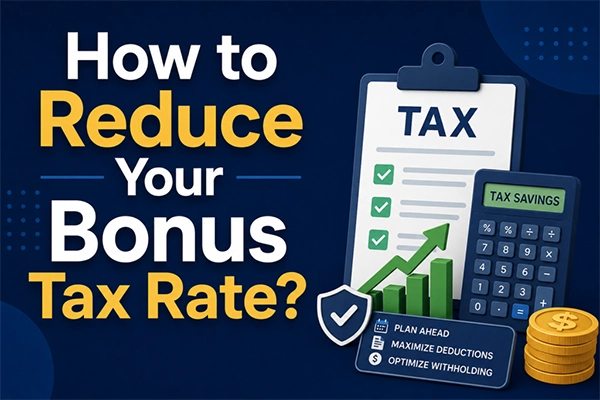
Review Form W-4, contribute to 401(K) and HSA, defer your bonus, use tax deductions, and check out the taxable bonus to reduce your bonus tax rate.
Here are some basic tips to save your tax bill.
Bonuses can be received at any time during the year. That is why you need to review your Form W-4 to adjust your additional income at the end of the calendar year. The IRS Tax Withholding Estimator can help you calculate your withholding amount and reduce your tax bill.
| Tip: If you don’t know how to fill out or adjust Form W-4 information, you should hire a financial consultant to ease your work. |
If your employer provides a 401(k) retirement account, you can easily move your bonus into it. Also, you can contribute to a health savings account (HSA). This helps you reduce your current taxable amount and lower your IRS tax bracket.
When you expect a lower income for the next month or year, you can request that your employer move your bonus. It helps you take advantage of a lower tax bracket, but the IRS considers it taxable.
Tax deductions are one of the best ways to reduce your fixed expenses from your final tax bill. You can deduct your donations, medical costs, education expenses, mortgage interest, etc., from your annual income. It can decrease your tax liability. Businesses should also consider proper sales tax services to maintain overall tax compliance
If your employer offers a bonus as cash, a gift, or a high-value product, you can pay the bonus tax rate. On the other hand, bonuses like movie tickets and holiday packages are nontaxable. So, check out whether your bonus is taxable or not.
Companies can reduce the employee turnover rate, increase productivity, and use business tax reductions.
Here are the benefits of giving bonuses to employees for organizations.
Obviously, everyone likes bonuses! If a company rewards employees for their hard work or success, it motivates them to stay with it for a long time. This results in reducing the employee turnover rate in an organization.
When workers feel rewarded and respected, they are motivated to increase productivity. According to the National Library of Medicine, incentives boost productivity in job performance.
Companies also reduce their tax bill by making additional payments to their employees. “Payment to employees” is deductible as a business expense. So, it’s important to give bonuses based on performance rather than gender, age, or regional discrimination. These financial records can also support business valuation services during strategic planning, mergers, or fundraising.
No, not all bonuses are taxable. The IRS considers rewards such as cash, gift cards, or high-value gifts taxable.
Let’s take a look at some nontaxable examples!
Also Read: How to Build Credit Fast: A Step-by-Step Guide for 2026
Overall, receiving a bonus makes employees happy and feel appreciated. But it also increases your federal income and raises your tax bracket. That is why you need to calculate the bonus tax rate and practice some tips to save your tax bill.
If you are a beginner or confused about calculating the bonus tax rate, you can hire Accountance services for expert guidance, including international tax services for businesses and individuals with cross-border tax obligations.
No, bonuses are not taxed at 40%. The IRS withholds bonuses at 22% for up to the first $1 million and 37% for the next $1 million.
You will pay up to a 22% bonus tax rate to the IRS. It means that you are not required to pay a higher tax than your regular salary.
No, bonuses are only taxed once a year. The IRS taxed your bonus the same as your regular annual income.
You can avoid high bonus taxes through the following tips:
Sources:
Tax Withholding – IRS (Internal Revenue Service)