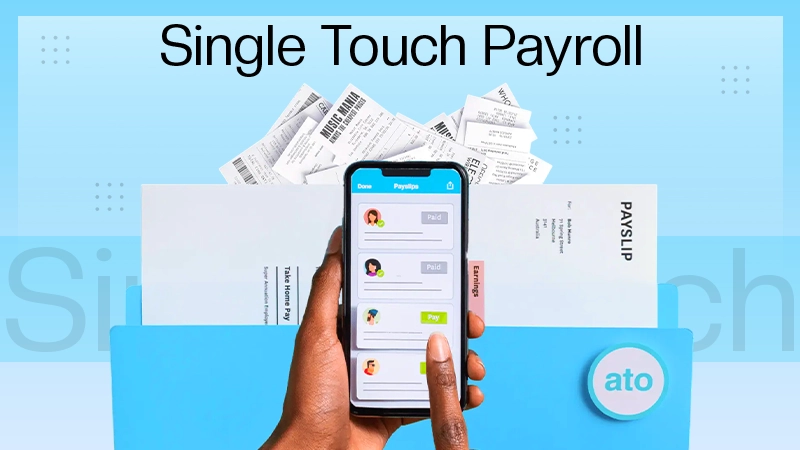


What is Single Touch Payroll? Well, it is a new technology that is transforming the way that employers report payroll data to the Australian Taxation Office (ATO). Businesses used to only report payroll at the end of the year, but with STP, they report payroll every time they make a pay run, including employee wages, tax, and superannuation data. This live reporting feature increases payroll accuracy, makes compliance easier, and saves admin time.
In this guide, we will take you through Single Touch Payroll, who will need to use it, the benefits, and the key reporting requirements required by employers.

Single Touch Payroll definition is a new online payroll reporting system for the Australian Taxation Office (ATO). It allows employers to submit employee payroll data electronically anytime an employee is paid.
Employers do not have to create annual payroll reports/payment summaries and instead submit payroll data to the ATO via STP-compliant payroll software on a pay run basis.
Typically, the information reported will contain employee wages, PAYG withholding amounts, superannuation obligations, and other payroll information.
STP does not alter the frequency of employee payments, nor does it affect the way payroll is handled. Rather, it is a streamlined report on payroll data to the government, which can drastically ease the administrative burden throughout the year.
Now that you know what is Single Touch Payroll, let’s go ahead and learn when it was actually introduced.
Employers used to report payroll at the end of the financial year. It meant extra paperwork and the chance of reporting errors.
Gone are the days of cumbersome payroll reporting and the inaccuracy of tax and super information, the Australian Government’s solution is Single Touch Payroll (STP).
Some of the main objectives of STP include:
Employers who submit payroll data throughout the year will be able to detect and fix problems earlier rather than year’s end.
Check Out: What is Investor Relations? Key Functions, Benefits, and Challenges
Most Australian employers with one or more employees will need to implement Single Touch Payroll.
These range from small to large enterprises, such as:
Unless there’s a PAYG tax reporting exemption or PAYG tax reporting concession for you, you’ll have to report payroll information in STP-enabled software if your business pays an employee and withholds PAYG tax.
Some of the people who may be covered by STP include:
It is important that businesses are aware of their reporting requirements and that the payroll software they use meets the existing STP requirements.
Single Touch Payroll definition is intended to integrate with your current payroll system. Once your payroll software is configured, reporting will occur as part of your regular pay run.
Here’s the procedure that follows:
Step 1: Process the Employee Payroll
Use your payroll software to work out employee wages, overtime, allowances, deductions, and superannuation.
Step 2: Review the Payroll Information
Review all employee information before submission of payroll to ensure payroll, tax, and super amounts are correct.
Step 3: Pay Employees
Employees are paid on the regular pay schedule with proper bank statements.
Step 4: Submit the Report
Once your payroll software has been processed, it will automatically transmit the needed payroll data via the STP to the ATO.
Step 5: Repeat for Every Pay Cycle
Your reporting process will be the same each time you get paid: weekly, fortnightly, or monthly.
Since reporting is part of the payroll process, employers will typically spend less time preparing separate payroll reports throughout the year.
All STP reports will contain payroll data for all employees paid in the pay run. Reporting information will vary depending on your payroll situation and may include:
Reporting allows for up-to-date payroll records for employees and assists in tax reporting at year’s end.
Single Touch Payroll Phase 2 increased the data that employers report via STP.
The goal of phase 2 is to enhance the quality of payroll information reported to government agencies and to minimize the reporting burden for the employer.
These information should be reported:
Most of the contemporary payroll software has support for STP Phase-2; however, employers should check if their software is up-to-date with the current reporting needs.
STP isn’t necessarily a compliance measurement, but it can provide some practical benefits for employers and employees.
An STP report is normally filed by the employer on the same day that employees are paid.
Reporting is done on the same frequency as your payroll schedule.
For example:
Once a report has been submitted, there is a possibility that some corrections may be necessary; employers can likely do this by updating the information through their payroll software.
Single Touch Payroll meaning that employers can help, but there are common reporting errors that should be avoided, even with the use of automated payroll software.
Single Touch Payroll meaning is a new way to report payroll that simplifies how Australian employers report payroll data to the ATO every time they make a payroll report. Although STP is a business requirement for most companies, it also helps minimize administrative tasks, improve accuracy in reporting, and ease year-end obligations.
Employers can achieve payroll compliance and handle their payroll operations with confidence and efficiency by leveraging STP compliance payroll software, ensuring accurate employee records, and reporting timely.
Read Next: Profit and Loss Statement: Its Importance, How It Works, and Errors to Avoid
Single Touch Payroll (STP) is a reporting system provided by the ATO where the employer reports wages, PAYG withholding, and superannuation details to the ATO with every payroll. It streamlines the reporting of payroll and assists businesses in compliance with payroll requirements.
STP is mandatory for most employers who have one or more employees to use payroll software that integrates with the ATO. There may be limited reporting concessions in certain situations.
An STP report is usually required to be submitted by the employer by or before the pay day. The reporting time is set according to the payroll period of the business, whether it is weekly, fortnightly, or monthly.
Sources:
What STP is – By Australian Government